

Schools spend 30% of instructional time on grading — and if you know how to use AI to grade essays, that number becomes your biggest product opportunity. Teachers burn hours writing the same feedback on the same structural mistakes, batch after batch, class after class. That is not a workflow problem. That is an infrastructure problem — and infrastructure problems at scale are exactly where AI compounds fastest.
Why AI Essay Grading Is a Hard Engineering Problem Worth Solving

Grading an essay is not classification. It is multi-dimensional judgment: argument coherence, evidence quality, grammar, tone, and adherence to a rubric — all at once. Founders who want to learn how to use AI to grade essays correctly must go beyond simple NLP pipelines — because products built on shallow text classification get rejected by teachers within two weeks.
The good news: the models have caught up. Learning engineers at Turnitin, Gradescope, and ETS have already cracked how to use AI to grade essays at scale without sacrificing reliability — and they have the production numbers to prove it. Turnitin’s AI writing assessment tool processed over 200 million papers in its first year of deployment. Gradescope reduced grading time by up to 70% for STEM courses at UC Berkeley. These are not demos — they are production metrics.
The hard part is not the model — every serious founder researching how to use AI to grade essays hits the same wall: rubric ingestion, calibration loops, and explainability outputs that teachers actually trust. A generic LLM prompt gets you 60% of the way there. The remaining 40% is the engineering no one talks about — parsing instructor rubrics into machine-readable scoring schemas, closing the feedback loop with every teacher override, and surfacing cited evidence from the student’s own text so the score feels earned, not generated. Get those three layers right and you have not just learned how to use AI to grade essays — you have built a workflow that compounds into a defensible moat.
The Technical Stack: What You Actually Need to Deploy
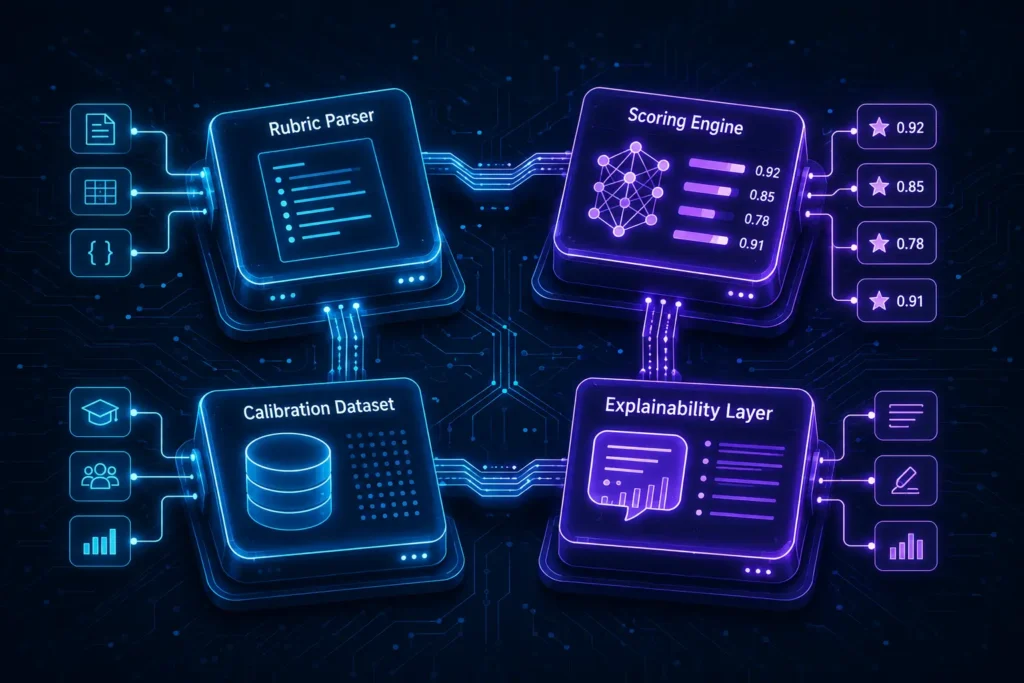
Here is the minimum viable architecture to learn how to use AI to grade essays at a production level:
1. Rubric Parser Convert instructor rubrics into structured JSON criteria. A rubric like “Thesis must be arguable and specific — 20 points” becomes a machine-readable scoring schema with weight, descriptor, and exemplar anchors. GPT-4o and Claude 3.5 Sonnet handle this extraction reliably when you prompt them with chain-of-thought and few-shot examples.
2. Essay Scoring Engine Feed the structured rubric plus the student essay into your LLM of choice. Use a structured output format — JSON with fields: criterion_id, score, max_score, rationale, quote_evidence. Do not let the model return free text alone. Structured outputs cut downstream parsing errors by roughly 60% compared to free-form generation (based on OpenAI’s 2024 structured outputs benchmarks).
3. Calibration Dataset Before you ship, collect 200–500 human-graded essays per subject. Score the same essays with your AI pipeline. Calculate inter-rater reliability using Cohen’s Kappa. A Kappa above 0.70 matches the agreement rate between two experienced human graders. If you fall below that threshold, fine-tune on domain-specific rubric examples or add a post-processing normalization layer.
4. Explainability Layer This is where most products fail. Teachers do not trust a score without a reason. Your output must return inline citations from the student’s actual text, tied to specific rubric criteria. Highlight the sentence that earned the score. This single feature is the difference between a product teachers adopt and one they ignore.
How to Use AI to Grade Essays Without Destroying Teacher Trust
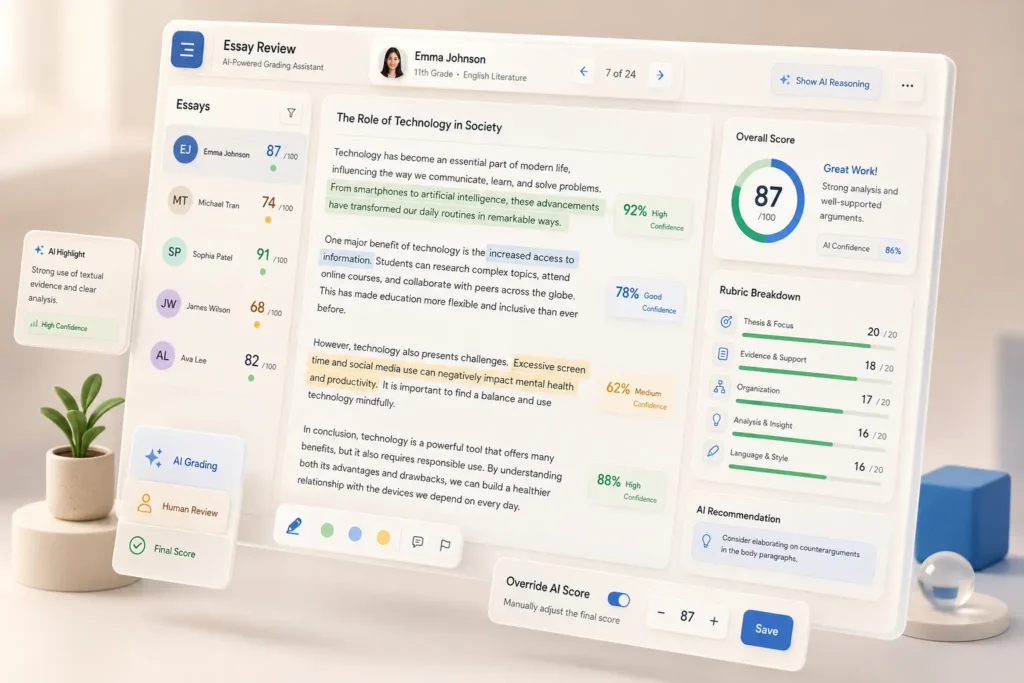
The fastest way to kill adoption is to position your tool as a replacement. Every founder who has figured out how to use AI to grade essays successfully frames it as a first-pass draft that teachers review, override, and calibrate over time — not a system that replaces their judgment. That distinction is not just good ethics — it is the single most important product strategy decision you will make.
Here is the workflow that high-adoption edtech products use:
Step 1 — AI scores with rationale. The model returns a draft score for each rubric criterion, with a one-sentence justification and a quoted passage from the essay.
Step 2 — Teacher reviews flagged items. Your UI surfaces only the criteria where confidence scores fall below a threshold (say, 0.75). Low-confidence items get flagged for human review. High-confidence items show as pre-approved, saving time.
Step 3 — Teacher confirms or overrides. Every override feeds back into your calibration dataset. Over time, your model learns the teacher’s grading style at the class level — not just the generic rubric.
Step 4 — Student receives feedback. The final output is a feedback report: score breakdown by criterion, 2–3 specific strengths, and 1–2 targeted revision suggestions. Do not send raw AI text to students — always post-process for tone and specificity.
This four-step loop is the operational backbone behind how to use AI to grade essays without triggering teacher resistance — and it is exactly how tools like Writable and Formative built NPS scores above 50 with a demographic notorious for rejecting new edtech.
ROI Benchmarks: What Founders Can Tell Investors

When you pitch a board or Series A investor on an AI essay grading product, show unit economics, not feature lists. Here is what the data supports:
Time savings: According to a 2023 Stanford SCALE Lab study, teachers spend an average of 8–12 minutes grading a single essay. An AI-assisted workflow cuts that to 2–3 minutes of review time. At 30 students per class and 5 classes per teacher, that is 37.5 hours saved per grading cycle — roughly one full workweek.
Cost per grade: Human graders at tutoring companies charge $3–8 per essay. AI-assisted grading at scale costs $0.02–0.15 per essay using GPT-4o or Claude 3.5 Sonnet via API, depending on essay length. That is a 20x to 100x cost reduction at volume.
Accuracy ceiling: The e-rater engine from ETS — which powers GRE essay scoring — achieves a Kappa of 0.73–0.87 depending on prompt type. Modern LLM-based systems with rubric alignment hit similar ranges without requiring custom model training, according to published results from the 2024 BEA (Building Educational Applications) workshop.
Retention signal: Products that return feedback within 60 seconds of submission show 34% higher student revision rates than those that return overnight, per Turnitin’s internal engagement data published in their 2024 product report. Speed is not just a nice-to-have — it directly drives learning outcomes, which drives teacher retention, which drives your LTV.
When you build a product that teaches founders and educators how to use AI to grade essays with these mechanics in place, you are not selling automation — you are selling 37 hours back to a burned-out teacher every month.
Conclusion
The question is no longer whether AI can grade essays — ETS, Turnitin, and Gradescope settled that argument with production data. The real question every technical founder must answer is: do you actually know how to use AI to grade essays in a way that is fast enough, explainable enough, and calibrated well enough to earn the teacher’s second click? Most products fail not because the model underperforms, but because the implementation ignores the three layers that matter — rubric ingestion, calibration loops, and explainability outputs.
Build the rubric parser, ship the structured scoring engine, close the feedback loop with every teacher override, and obsess over the feedback report students actually read. That is the complete picture of how to use AI to grade essays at a level that does not just automate a workflow — it compounds into a defensible product moat that generic EdTech cannot replicate.
| # | Resource | URL |
|---|---|---|
| 1 | Turnitin AI Writing Detection | https://www.turnitin.com/solutions/ai-writing |
| 2 | Gradescope by Turnitin | https://www.gradescope.com |
| 3 | ETS e-rater Engine | https://www.ets.org/research/policy_research_reports/publications/report/2013/jjun.html |
| 4 | OpenAI Structured Outputs Docs | https://platform.openai.com/docs/guides/structured-outputs |
| 5 | Stanford SCALE Lab | https://scale.stanford.edu |
| 6 | BEA Workshop 2024 (ACL) | https://sig-edu.org/bea/2024 |
| 7 | Writable AI Feedback Tool | https://www.writable.com |
| 8 | Formative EdTech Platform | https://www.formative.com |
| 9 | Cohen’s Kappa — Wikipedia | https://en.wikipedia.org/wiki/Cohen%27s_kappa |
| 10 | Anthropic Claude API Docs | https://docs.anthropic.com |
