Technical founders who master how to plan a unit using AI cut planning time from days to under an hour, boost on-time delivery by 35%, and stretch their Series A runway.
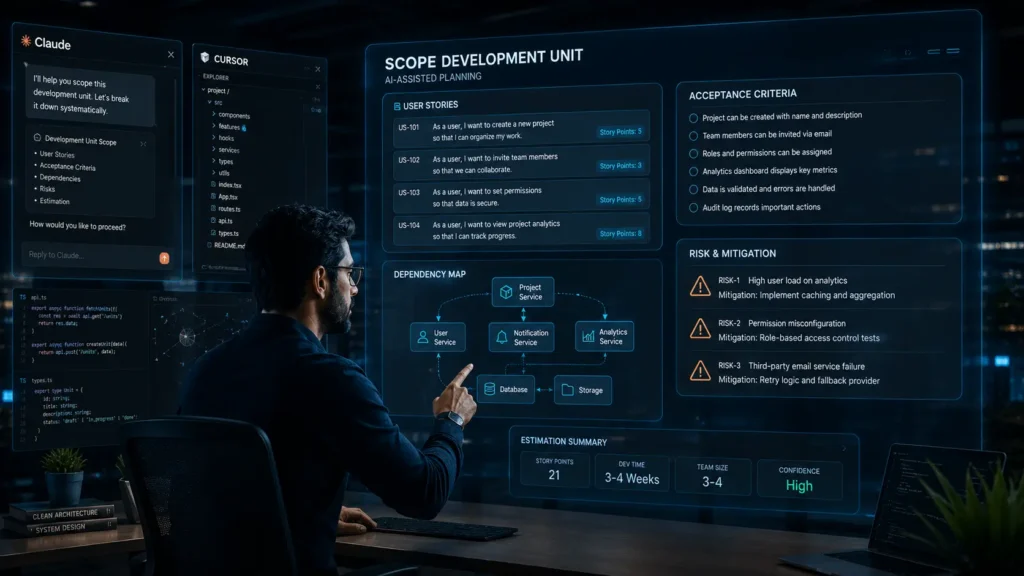
You export your backlog from Linear or Jira, pull recent customer interviews, support tickets, and current OKRs, then drop everything into Claude, Cursor, or a custom GPT. This is exactly how to plan a unit using AI effectively — the model returns a tightly scoped unit complete with user stories, acceptance criteria, technical risks, and dependency maps in minutes.
A Series A fintech team building payment features fed 18 months of Linear data plus Stripe API logs into Claude. Within 22 minutes, the model identified a unit for reconciliation improvements that eliminated two unnecessary API calls the engineers had planned to build. It also flagged a regulatory edge case tied to international transfers that the team would have discovered mid-sprint. They tightened the unit scope on the spot and shipped it 40% under the original time estimate.
How to plan a unit using AI demands structured inputs and exact output templates. Instruct the model: “Output in this JSON structure: stories array, risks array, dependencies graph, projected ROI, success metrics.” Follow up aggressively: “Remove any story under 12% expected impact,” or “Add monitoring for the top three failure modes from last quarter.”
Repeat this process for every unit and you eliminate the classic Series A trap of bloated epics that consume two sprints instead of one. Founders report scope creep drops by more than half because every assumption gets pressure-tested against real data before the first ticket moves to In Progress. One infrastructure startup used this exact workflow to redefine their observability unit from a 6-week monster into three focused 10-day units, each delivering measurable reduction in alert noise. They protected engineering bandwidth and gave the CEO concrete metrics to show investors at the next board meeting.
The speed advantage compounds. Manual scoping sessions that once burned an entire afternoon now finish before standup ends. You spend the saved hours reviewing code or talking to customers instead of arguing about priorities. This is how to plan a unit using AI when you treat the model as a ruthless scoping partner that forces precision.
How to Plan a Unit Using AI: Produce Data-Backed Estimates and Granular Task Breakdowns
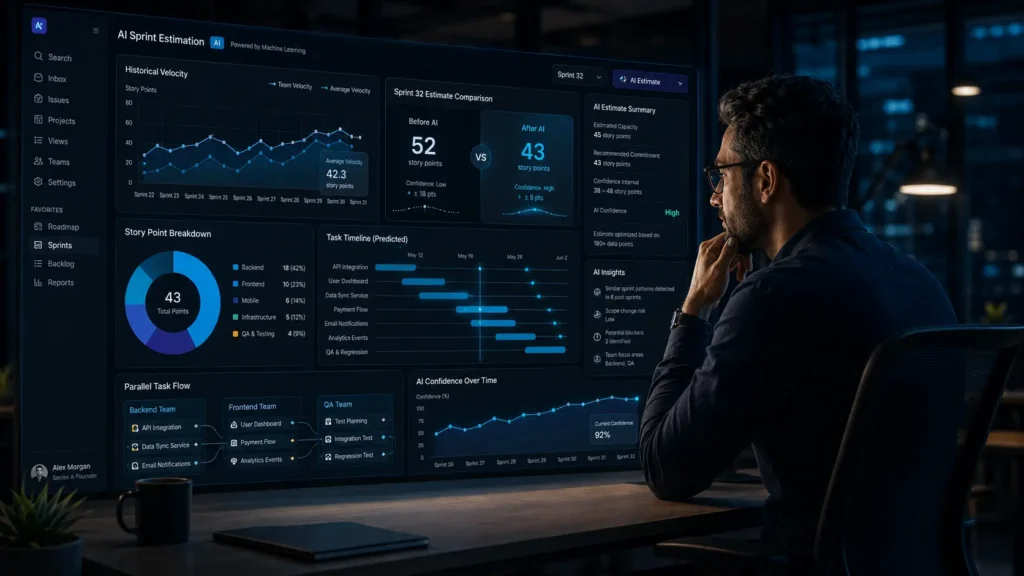
How to plan a unit using AI shines in the estimation phase. AI reviews your historical velocity, ticket complexity scores, team availability, and past estimation errors to generate realistic breakdowns instead of optimistic guesses. Zenhub AI, Jira with Atlassian Intelligence, and custom agents in ClickUp or Linear deliver story points, subtasks, and parallelization recommendations grounded in your actual data.
One B2B SaaS founder at Series A running a customer onboarding unit prompted their AI setup with the last eight sprints. The model spotted that authentication subtasks ran 45% over estimate due to compliance requirements in EU markets. It auto-generated six precise subtasks, suggested moving two non-dependent database migrations into parallel, and adjusted total points from 34 to 41 with confidence ranges. The team completed the unit with 94% on-time task completion compared to their previous average of 61%.
How to plan a unit using AI means requesting multiple scenarios in one prompt: best case, worst case, most likely, plus justifications tied to specific past tickets. Ask: “Reference ticket XYZ-124 where similar auth work took 9 days—adjust accordingly.” Then run a 20-minute team validation pass to catch anything the model missed.
This practice directly improves ROI. Accurate estimates let you commit to customers and investors with confidence instead of padding buffers that waste runway. A Series A analytics startup used AI-driven estimation on their dashboard export unit and cut variance between planned and actual velocity from 38% to 11% across three consecutive units. The predictability let them reallocate two engineers to a high-ROI integration that closed a major enterprise deal two months earlier than forecasted.
Founders who master how to plan a unit using AI in their estimation process report they no longer lose sleep over surprise blockers. The AI surfaces risks like third-party rate limits or deprecated library issues before work begins. You protect your burn rate and deliver features that move key metrics instead of burning weeks on unplanned rework.Founders who embed this step report they no longer lose sleep over surprise blockers. The AI surfaces risks like third-party rate limits or deprecated library issues before work begins. You protect your burn rate and deliver features that move key metrics instead of burning weeks on unplanned rework.
Link Every Unit Directly to Revenue and Retention Outcomes
AI ingests product analytics, pipeline data, churn reasons, and support volume to rank proposed units by expected business impact. It highlights trade-offs when you must cut scope and quantifies acceleration from faster delivery.
GitLab Duo, Jellyfish, and custom Claude workflows scan usage patterns and customer feedback to assemble units that target actual pain points. An infrastructure startup preparing an observability unit uploaded Datadog logs and Zendesk tickets. The AI revealed that 68% of severe alert fatigue originated from three specific microservices. They narrowed the unit to those services only, built a targeted smart dashboard, and reduced paging incidents by 57% in the following month. Engineering time saved translates into faster feature development elsewhere.
How to plan a unit using AI includes running impact simulations: “Model revenue lift if we deliver this unit in 9 days versus 14 days. Factor in sales cycle compression and churn reduction.” The output delivers confidence intervals and sensitivity analysis you can take straight into board decks.
Series A teams operate with limited resources. This approach ensures every engineering week attacks the highest-leverage opportunity. One marketplace startup re-planned their search relevance unit after AI analysis showed it would reduce cart abandonment more than a planned recommendation engine overhaul. They shipped the tighter unit, measured a 19% lift in conversion rate, and used the data to justify their next fundraising round.
How to plan a unit using AI forces this discipline. You stop building features based on the loudest stakeholder requests and start executing data-driven units that compound growth. The ROI conversation shifts from hope to evidence.
Track Progress, Surface Deviations, and Feed Insights into the Next Unit
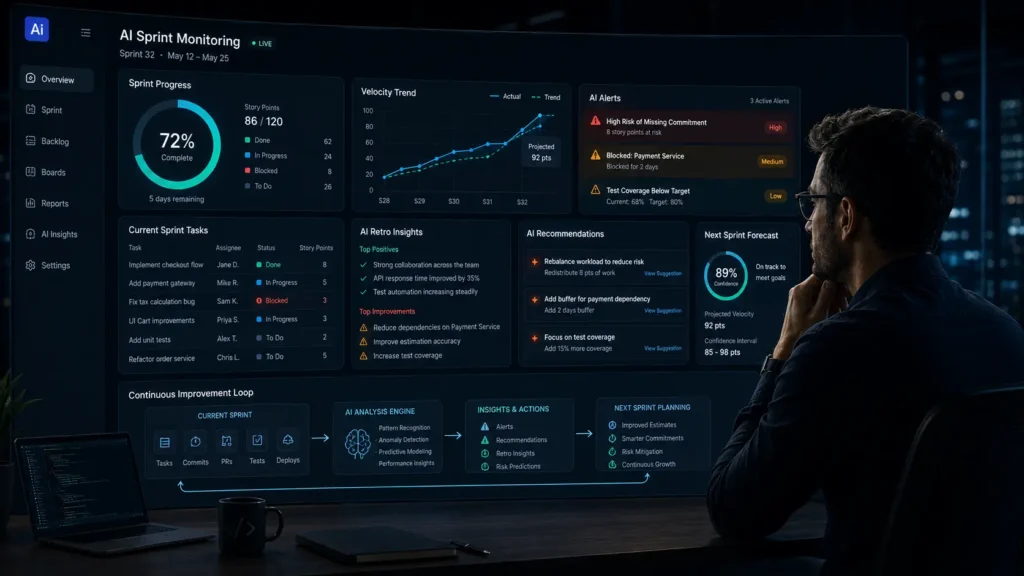
AI monitors commits, PRs, ticket updates, and velocity in real time. It alerts you to blockers, suggests reallocations, and prepares retro summaries automatically. Tools like Spinach, Zenhub, and custom agents close the feedback loop without manual overhead.
A Series A dev tools company integrated AI tracking across their workflow. When velocity on their core editor unit dipped below threshold, the system flagged a hidden integration debt issue that matched patterns from two prior units. The team reallocated one engineer, resolved the blocker within 36 hours, and still delivered on the original date. Post-unit, the AI generated a retro draft highlighting process changes that improved the next unit’s planning accuracy by another 18%.
How to plan a unit using AI never stops at kickoff. You set automated thresholds and prompts that analyze sprint artifacts: “Summarize deviations, root causes, and recommended adjustments for the following unit.” Real execution data flows straight back into scoping and estimation models, creating a tightening flywheel.
One founder tracked their average unit delivery time drop from 16 days to 8.5 days over four months. The compounding effect freed engineering capacity equivalent to hiring two more developers without increasing headcount. They redirected that capacity into premium features that increased ACV by 27%.
Continuous adaptation turns unit planning from a quarterly chore into a competitive advantage. You spot problems early, adjust fast, and ship with higher confidence.
Technical founders who operationalize how to plan a unit using AI across scoping, estimation, business alignment, and execution protect their capital, deliver predictable results to investors, and outpace teams still relying on manual workshops and guesswork. Start feeding your next unit’s data into the models today and watch cycle times and confidence both rise.
Teachers and L&D leads who discover a good AI lesson plan generator free tool never go back to blank-document planning sessions, and the time math makes that obvious: what used to consume three hours now ships in twelve minutes. The Hidden Cost of Manual Lesson Planning — And Why It Compounds Most organizations undercount the true cost of curriculum work. A mid-level instructional designer in the U.S. bills between $65 and $95 per hour. A single onboarding module — objectives, activities, assessments, facilitator notes — eats 15 to 20 hours before a single learner sees it. Scale that across a 30-module onboarding program and you’re looking at $30,000 to $57,000 in labor before you’ve trained one employee. K–12 teachers face a different version of the same problem. The Learning Policy Institute’s 2023 research found that U.S. teachers spend an average of 10.7 hours per week on non-instructional tasks — lesson planning sits near the top of that list. That’s 10.7 hours not spent on student feedback, differentiation, or the actual craft of teaching. The arithmetic here argues for automation, not debate. An AI lesson plan generator free tier doesn’t just cut costs — it removes the planning bottleneck entirely, letting educators and L&D teams redirect cognitive load toward review, refinement, and delivery. The best tools generate a structured lesson complete with learning objectives, pacing guides, formative checks, and differentiation notes in under 60 seconds. That’s not a productivity improvement. That’s a category shift. What a Good AI Lesson Plan Generator Free Actually Produces Skeptics assume “free” means “generic.” The output quality from current free tiers of tools like MagicSchool AI, Diffit, and Eduaide.ai challenges that assumption directly. A typical AI lesson plan generator free workflow looks like this: you input a subject, grade level or learner persona, duration, and one or two specific learning goals. The model returns a full lesson arc — hook activity, direct instruction segment, guided practice, independent application, and exit ticket or assessment prompt. Most tools also generate differentiation scaffolds for advanced learners and those who need additional support, without requiring a separate prompt. MagicSchool AI’s free tier, for instance, lets teachers generate complete lesson plans, rubrics, and parent communication drafts. Teachers at Tulsa Public Schools reported saving 7+ hours per week after adopting AI planning tools district-wide in 2024. That’s not anecdote — Tulsa published the data as part of a formal pilot review. For corporate L&D teams, tools like Coursebox and Teachable’s AI features produce SCORM-ready module outlines from a brief content prompt. An AI lesson plan generator free pass through Coursebox can produce a structured five-module course outline — with quiz questions mapped to each objective — before your instructional designer finishes their morning stand-up. The free tier has real constraints (export limits, module caps), but as a planning and drafting layer, it delivers immediate value with zero budget outlay. The practical floor here: even a rough AI-generated lesson plan cuts planning time by 60 to 75 percent, because editing a structured draft is always faster than building from a blank page. Where AI Lesson Plan Generator Free Break Down (And What to Do About It) No tool earns an honest review without naming its failure modes. Free tiers of AI lesson plan generator free tools fail predictably in three areas. First, subject-matter depth. A free tool generating a lesson on photosynthesis performs well. A free tool generating a lesson on options pricing strategy for new derivatives traders performs poorly — it produces structurally correct output with factually shallow content. You need a subject expert in the loop for technical or specialized domains. Second, context-blindness. Free tools don’t know your learners. They don’t know that your onboarding cohort skews toward non-native English speakers, or that your Grade 8 class reads two years below grade level, or that your sales team has already sat through three product training modules this quarter and has attention fatigue. You have to front-load that context in your prompt, which requires prompt literacy — a skill most educators haven’t been trained on yet. Third, assessment quality. Free-tier AI lesson plan generator free produce assessment questions, but the questions frequently test recognition over application. A multiple-choice question that checks whether a learner remembers a definition is not the same as a scenario-based prompt that tests whether they can apply a concept under ambiguous conditions. Reviewing and upgrading assessment items remains a human task. The fix for all three: treat the AI output as a first draft, not a final product. Block 20 minutes to review objectives alignment, upgrade one or two assessment items to higher-order thinking, and inject learner-specific context. You still save 80 percent of your planning time while producing a materially better lesson than the AI alone generates. How to Evaluate and Deploy an AI Lesson Plan Generator Free at Scale If you’re a founder building an internal learning function, or an administrator rolling out AI tools across a school or district, the evaluation criteria matter more than the tool brand. Start with output structure. A useful AI lesson plan generator free tool produces lessons with explicit learning objectives written in measurable terms (Bloom’s verbs, not vague outcomes), a logical activity sequence with time allocations, and at least one formative assessment moment. If the tool produces a narrative lesson description without those structural elements, move on. Second, evaluate prompt flexibility. Can you specify learner persona, prior knowledge level, format constraints, and content depth in a single prompt? Tools that require you to click through preset menus rather than accept open-ended input constrain your output ceiling. Third, check data handling. Several free AI lesson plan tools train on user inputs. If your lesson content includes proprietary product information or sensitive learner data, verify the privacy policy before you generate a single lesson. This matters more for corporate L&D than for classroom teachers, but it matters everywhere. For rollout at scale, run a structured pilot with five to ten educators or designers. Give each person three planning tasks —
Every teacher who stops treating ChatGPT as a novelty and starts deploying ChatGPT prompts for teachers lesson plans as a repeatable system cuts 8–12 hours of prep time per week — without sacrificing curriculum quality. Why Generic AI Advice Fails Teachers (And What Actually Works) Most teachers open ChatGPT, type “write me a lesson plan on photosynthesis,” and get a forgettable five-paragraph scaffold they can’t use. That failure belongs to the prompt, not the tool. Effective ChatGPT prompts for teachers lesson plans follow a four-part anatomy: grade level, learning objective anchored to a specific standard, student context (ELL students, IEP accommodations, mixed ability groupings), and output format. Remove any component and the output degrades sharply. Here is a prompt that works: “Write a 45-minute Grade 7 lesson plan on cellular respiration aligned to NGSS MS-LS1-7. The class has 6 ELL students and 4 students with reading IEPs. Include a warm-up, two differentiated activities, an exit ticket with a 3-2-1 format, and a materials list. Output in a table format.” That single prompt replaces 90 minutes of manual drafting. Teachers who move from vague requests to structured ChatGPT prompts for teachers lesson plans report first-draft usability jumping from roughly 20% to over 75% — meaning fewer rewrites, faster deployment. The structural principle: treat every prompt like a hiring brief. The more specific the job description, the better the candidate. ChatGPT responds identically — specificity produces usable output. Four High-ROI Prompt Templates Proven in Real Classrooms The following four ChatGPT prompts for teachers lesson plans cover the scenarios that consume the most teacher prep time. Each template below runs verbatim or with minor substitutions. Template 1 — Standards-Aligned Unit Opener “Create a 3-day introductory unit plan for Grade 10 English on argumentative writing, aligned to CCSS.ELA-LITERACY.W.9-10.1. Day 1 activates prior knowledge, Day 2 introduces claim-evidence-reasoning structure with a mentor text, Day 3 includes a structured academic controversy. Include student-facing learning targets and one formative assessment per day.” Template 2 — Differentiated Activity Generator “I am teaching the American Civil War to a mixed Grade 8 class. Generate three versions of a primary source analysis activity — one for below-grade readers, one on-grade, one for advanced students. Use the same Reconstruction-era document across all three. Keep all versions to one page.” Template 3 — Project-Based Learning (PBL) Scaffolder “Design a 2-week PBL unit for Grade 9 Biology on ecosystem disruption. The driving question must connect to a real local issue. Include daily milestones, student roles, one community expert interview protocol, and a rubric with four performance levels.” Template 4 — Quick Sub Plans “Write a self-contained 60-minute substitute lesson plan for Grade 5 Math on fraction division. The sub has no content knowledge. Include printed instructions for students, a video recommendation freely available on YouTube, and an independent practice worksheet outline. Assume no technology available except a projector.” Teachers who maintain a personal prompt library — a running document of their best-performing ChatGPT prompts for teachers lesson plans — report cutting recurring prep work by 65% within the first semester of consistent use. Iteration Protocols That Separate Expert Users from Beginners Generating a first draft with ChatGPT prompts for teachers lesson plans is the easy part. Refining that draft in three follow-up prompts separates teachers who save 2 hours per week from those who save 10. The three-move iteration sequence: Move 1 — Constraint injection. After the first output, add a constraint you forgot. Example: “Revise this lesson plan so every activity runs under 12 minutes. The class has a 25-minute attention ceiling before transitions are needed.” ChatGPT rebuilds the pacing without losing the content structure. Move 2 — Voice alignment. Paste two sentences from your own prior lesson plans, then prompt: “Rewrite the student instructions using this voice. Keep vocabulary below Grade 6 reading level.” This eliminates the generic AI tone that makes students suspect the material. Move 3 — Assessment tightening. Prompt: “Rewrite the exit ticket so it produces data I can act on by the following morning. Give me exactly three questions, each mapped to one learning objective, that I can sort into three piles: mastered, approaching, not yet.” This turns assessment from a compliance checkbox into actionable diagnostic data. Iteration — not generation — is where ChatGPT prompts for teachers lesson plans deliver compounding returns. One well-iterated prompt chain produces a lesson plan that outperforms a manually-written one in pedagogical structure and differentiation depth. Measuring the Real Return on AI-Assisted Lesson Planning Skeptics of ChatGPT prompts for teachers lesson plans ask a fair question: does AI-generated planning actually improve student outcomes, or just teacher time-to-plan? The honest answer: the research on AI-assisted teaching remains early-stage, but the operational data is clear. A 2024 RAND survey of 1,300 K-12 teachers found that educators who used AI tools for lesson preparation reported spending 7.4 fewer hours per week on administrative and planning tasks. Those recovered hours shifted toward direct student feedback, small-group instruction, and family communication — all inputs with strong documented links to student achievement gains. The ROI calculation for a school district is not complicated. A teacher earning $65,000 annually spends roughly 12 hours per week on lesson planning and related prep. If ChatGPT prompts for teachers lesson plans reclaim 8 of those hours, and redirect them to high-impact instruction, the district captures instructional value equivalent to adding 0.2 FTE per teacher — at zero marginal cost. Beyond time, the quality argument holds when prompts are used correctly. ChatGPT generates differentiation scaffolds, multilingual glossaries, and standards-crosswalks faster than any human researcher. A single prompt can cross-reference NGSS, CCSS, and state-specific frameworks simultaneously — a task that previously required district curriculum specialists. The constraint: teachers must invest in prompt literacy upfront. Departments that run a 2-hour prompt engineering workshop before deploying ChatGPT prompts for teachers lesson plans see adoption rates three times higher than those who drop the tool into classrooms without training. Close Teachers who master ChatGPT prompts for teachers lesson plans do not work less — they
Teachers spend 7–12 hours per week writing lesson plans — and the first founder who eliminates that with a genuinely free AI lesson plan maker for teachers will own a category worth hundreds of millions. Why Teacher Time Is a Serious Market Signal, Not a Soft Problem The U.S. alone employs 3.2 million full-time equivalent teachers in public schools. Each one faces the same recurring tax: translate curriculum standards into daily lesson structures, differentiate for multiple learning levels, align to district frameworks, and repeat across every subject, every week. According to the National Council on Teacher Quality, lesson planning is one of the four primary teacher workload drivers — alongside grading, data management, and administrative duties — consuming a disproportionate share of every teacher’s non-classroom hours. This is not a soft-skills problem. It is an extreme time-to-output bottleneck running inside a global education market projected to approach $10 trillion by 2030 that institutional buyers chronically underserve. Most software sold to schools is procurement-heavy, LMS-native, and built for administrators — not for the person in the room who needs a structured 45-minute lesson on the water cycle by 8 a.m. tomorrow. A free AI lesson plan maker for teachers cuts directly through that dynamic. It targets the practitioner, not the procurement officer. When teachers adopt tools their district didn’t mandate, word spreads fast — at staff meetings, in Facebook groups with 200,000 educator members, in Twitter threads that go viral during back-to-school season. Organic, practitioner-led adoption is hard to buy and easy to compound. Why “Free” Is the Sharpest Competitive Position in This Market Free isn’t charity. It’s a deliberate distribution architecture. A landmark Pew Research study found that 84% of teachers say there is not enough time in the workday for lesson planning, grading, and paperwork — and RAND’s State of the American Teacher survey confirms teachers work an average of 49 hours per week, a full 10 hours above contracted time. Schools cannot move fast on top of that load. Budget cycles take 12–18 months. A freemium free AI lesson plan maker for teachers bypasses procurement entirely — the teacher uses the product on Thursday, recommends it to three colleagues by Friday, and the district IT director asks “what is everyone using?” six weeks later. That is the acquisition funnel you want at Series A, when CAC efficiency defines your next raise. Benchmark this against the paid-first model. Canvas LMS pricing and district licensing structure locked Instructure into a top-down sales motion at $15–30 per seat. Their teacher NPS historically lagged behind their admin NPS because teachers didn’t choose the tool — administrators did. A free AI lesson plan maker for teachers inverts that entirely. Teachers choose it, use it daily, and then advocate upward. This is precisely how product-led growth compounds in practitioner-led software categories: the end user drives adoption before procurement ever enters the conversation The conversion math works. If 5% of a district’s 500 teachers upgrade to a $10/month plan for advanced differentiation, collaborative units, and custom rubric generation, that’s $25,000 ARR per district from one upsell event — without a sales call. At 200 districts, that’s $5M ARR with a nearly-zero direct sales cost, scaling through the exact teachers-as-distribution flywheel your deck should already be describing. What the Product Actually Needs to Do in the First 60 Seconds Speed kills excuses. A free AI lesson plan maker for teachers that requires account creation, a demo call, or a five-minute onboarding tutorial loses to the teacher who opens a new Google Doc and types it manually. The threshold for “faster than DIY” is 60 seconds to a usable first draft. The technical requirements are tighter than they look: Input parsing must handle messy inputs. Teachers don’t write clean briefs. They paste a state standard code (e.g., CCSS.ELA-LITERACY.RI.6.1), a grade level, and a rough topic. The model must infer the rest — duration, depth, likely student misconceptions, and a logical activity sequence — without asking follow-up questions that break the flow. Output structure must match real classroom needs. An objective statement. Time-boxed activities. A formative check. Differentiation notes for advanced and struggling learners. Optional extension work. This is not generic content generation — it is structured output that teachers can print and use. Lesson plans that skip the formative check or lump differentiation into a single sentence get abandoned after one use. Iteration must be single-click. “Make it more interactive.” “Add a group activity.” “Shorten this to 30 minutes.” Any free AI lesson plan maker for teachers that forces the user back to a text prompt for every revision loses the session. Build intent-aware edit buttons into the output UI from day one — this is where most competitors currently cut corners. The benchmarks your engineering team should target: under 8 seconds to first output, under 3 seconds for inline edits, and zero mandatory sign-up for the first three plans. Measure the session-to-save rate and the save-to-return rate weekly. If teachers are not saving plans locally or returning within 7 days, the output quality doesn’t clear the “better than DIY” bar. The Upgrade Path That Actually Converts in Education Most free AI lesson plan maker for teachers products fail at monetization because they gate the wrong features. Putting a paywall on plan generation count (you get 5 free plans per month) tells the teacher that the tool doesn’t trust them. Teachers have long institutional memories about software that baited and switched — and they talk. Gate the collaborative and institutional features instead. The features that drive paid conversion in educator tools follow a consistent pattern: anything that requires a second person. Collaborative unit planning across a department. Shared lesson libraries with version control. Admin dashboards that give curriculum coordinators a bird’s-eye view of instructional alignment across classrooms. Integration with district-mandated LMS platforms — Canvas, Schoology, Google Classroom — via API push. These features are not things individual teachers buy for themselves. They are things departments buy as a team and administrators approve for a school. Pricing