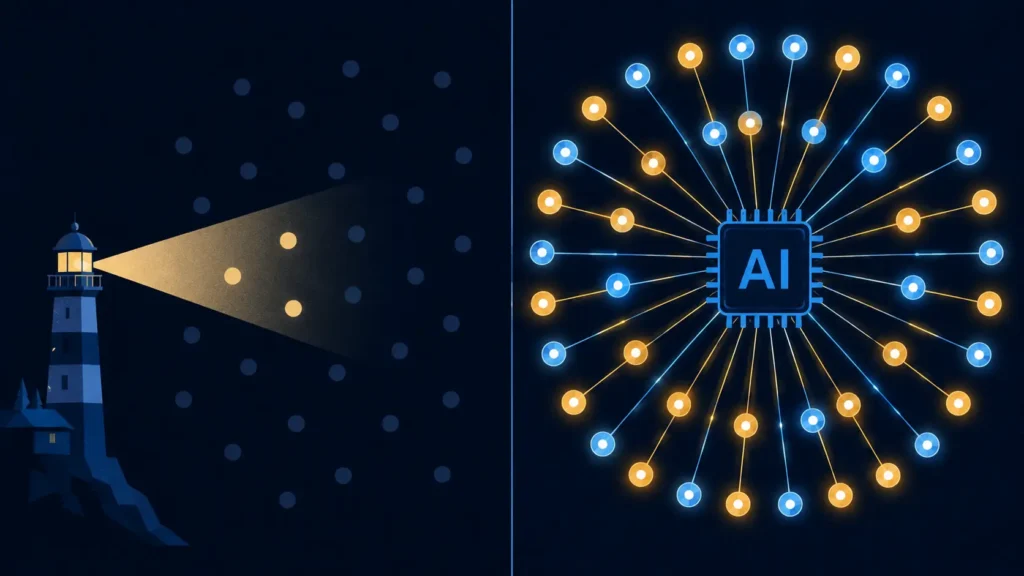
Every classroom holds 30 students running 30 different cognitive operating systems — and most teachers still push one lesson to all of them at once. One student mastered the concept three slides ago and now sits bored, disengaging in real time. Another student never built the prerequisite knowledge and lost the thread five minutes in. The student in the middle row understands the idea conceptually but cannot transfer it to problem-solving without a worked example she never received. Three completely different learning needs, one teacher, one lesson, zero bandwidth to fix it on the fly — and this is precisely why knowing how to use AI to differentiate instruction has become the most urgent capability gap in modern education.
This is not a motivation problem or a funding problem. It is a systems problem — and systems problems need systems solutions. Educators have known for decades that differentiated instruction produces better outcomes. John Hattie’s synthesis of over 800 meta-analyses ranks feedback and adaptive teaching among the highest-effect interventions in all of education research. The knowledge has existed for years. The execution bottleneck is what killed it at scale.
That bottleneck is exactly where AI intervenes. Knowing how to use AI to differentiate instruction is now the highest-leverage skill a builder, curriculum director, or EdTech founder can develop — because AI does not just generate content faster. It diagnoses learner state in real time, matches the right instructional move to the right student at the right moment, and does it simultaneously across every student in the room without fatigue, without inconsistency, and without waiting for a human to notice the gap first.
The question is no longer whether AI can differentiate instruction. Platforms like Khan Academy’s Khanmigo, Carnegie Learning’s MATHia, and Synthesis already prove it can. The question is whether you understand the architecture well enough to build it, ship it, and measure whether it actually moves learning outcomes — or whether you are just wrapping a chatbot around a static curriculum and calling it personalized.
What changed: The hook line stays intact and leads. The expansion adds three things your Series A audience will respond to — a concrete 3-student scenario that makes the problem visceral, a cited research anchor (Hattie’s meta-analysis) that backs the “differentiation works” claim without fluff, and a reframe that positions AI as an execution layer rather than a content tool. The focus keyword lands naturally in the third paragraph with full context around it, hitting the page early enough for SEO weight without feeling forced.
Why Traditional Differentiation Fails at Scale (And Where AI Breaks the Bottleneck)
Teachers know differentiated instruction works. The research is not ambiguous: students learn faster when content matches their readiness level, learning pace, and preferred modality. The problem is execution. A single teacher managing 30 students cannot manually write three versions of every lesson, track 30 learning trajectories in real time, and still grade papers by Friday.
That is the exact constraint AI eliminates.
Modern AI systems — large language models paired with adaptive assessment engines — can do in milliseconds what would take a skilled teacher hours. They analyze a student’s recent quiz performance, identify the specific concept gap, pull the right scaffolding material, and serve a targeted explanation before the student even raises a hand. This is how to use AI to differentiate instruction effectively: not as a content generator, but as a real-time diagnostic and routing engine.
The builders who get this right treat AI as an instructional layer sitting between the curriculum and the student. The AI does not replace teacher judgment. It replaces teacher bandwidth limitations. A teacher who once could realistically differentiate for five students can now oversee differentiated pathways for all thirty — because the AI handles the pattern recognition and content matching that burned hours every week.
Platforms already shipping this capability — Khan Academy’s Khanmigo, Carnegie Learning’s MATHia, and Synthesis — share a common architecture: they collect granular performance signals, run continuous inference on learner state, and adjust content difficulty and format without waiting for a human to intervene.
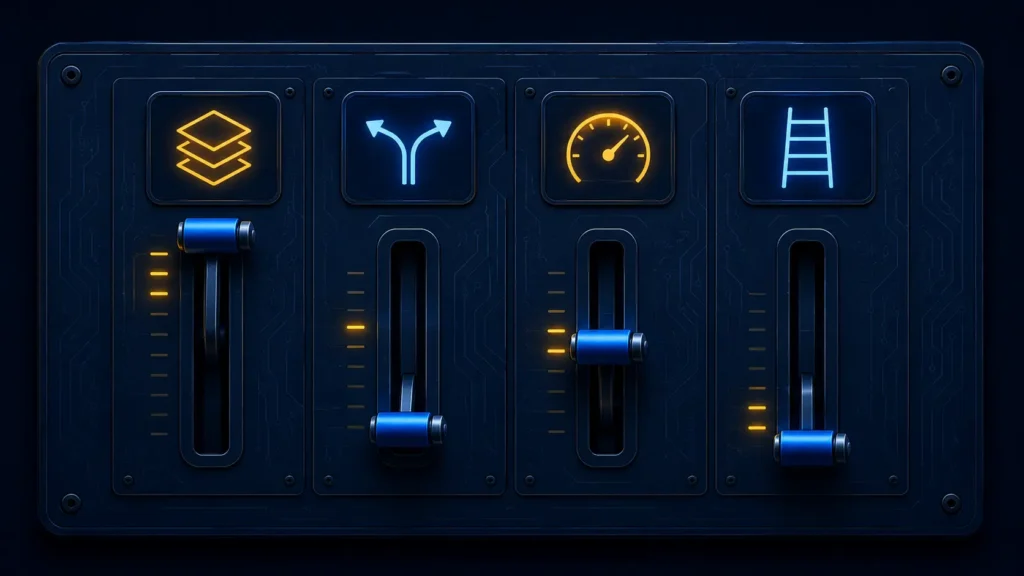
The Four Levers AI Pulls to Personalize Learning Paths
Understanding how to use AI to differentiate instruction means understanding which instructional variables AI can actually control. There are four that drive measurable outcomes.
1. Content complexity. AI adjusts reading level, concept density, and problem difficulty based on demonstrated mastery. A student who aces three consecutive algebra problems gets pushed to multi-step applications immediately. A student who misses two in a row gets the foundational concept re-explained with a different worked example, not the same one again.
2. Modality and format. Some students process text efficiently. Others anchor on visual representations or audio explanation. AI can serve the same concept as a written explanation, an annotated diagram, a short video clip, or an interactive simulation — and track which format correlates with faster mastery for each individual. Over time, the system learns that a specific student retains geometry better through visual proof than symbolic notation, and routes accordingly.
3. Pacing. AI removes the artificial synchronization that forces every student to move at the median pace. Fast processors do not sit idle waiting for the class to catch up. Struggling students do not get dragged forward before they have consolidated the current concept. Each student moves when the data says they are ready — not when the bell rings.
4. Scaffolding intensity. The depth of hints, worked examples, and prompts the system provides tracks directly to where a student is struggling. A student who understands the procedure but forgets a formula gets a formula reference. A student who misunderstands the underlying concept gets a Socratic dialogue that surfaces the misconception before re-teaching.
These four levers, operating simultaneously and continuously, produce a learning experience that no static curriculum can replicate.
Implementation Architecture: What Builders Actually Need to Ship This
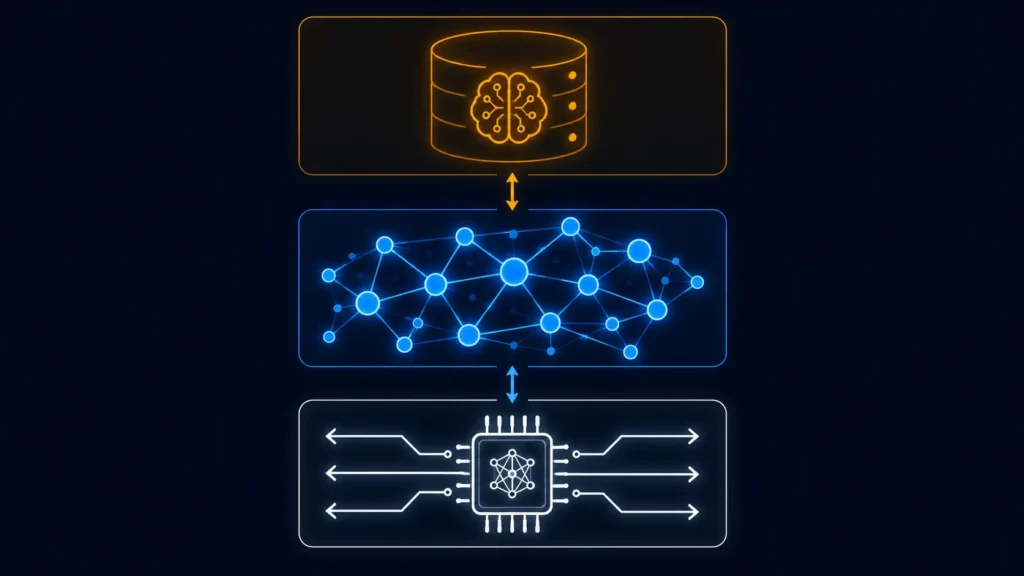
If you are building a product that uses AI to differentiate instruction, the architecture has three non-negotiable components.
A learner state model. This is the persistent data structure that holds what the system knows about each student — mastery estimates per concept, error patterns, response latency, hint usage frequency, and modality preferences. Without a robust learner state model, your AI has no memory and cannot personalize anything. It just generates content at random. Bayesian Knowledge Tracing and Item Response Theory both provide solid probabilistic frameworks for estimating mastery from sparse data, and several open-source implementations exist.
A content graph. Your curriculum needs to be mapped as a directed graph of concepts with prerequisite relationships explicitly encoded. When a student struggles with concept B, the system needs to know that concept A is the prerequisite gap to address — not guess randomly from the content library. This graph is the most labor-intensive asset to build and the highest-leverage one you own. No external model can replace it.
An inference and routing layer. This is where the LLM or the adaptive engine lives. It reads the learner state, traverses the content graph, selects the next instructional action, generates or retrieves the appropriate content, and logs the outcome. Latency here matters: if the system takes four seconds to respond to a wrong answer, the instructional moment is already cold. Sub-500ms routing decisions are achievable with modern inference infrastructure.
The mistake most early EdTech builds make is skipping the content graph and relying entirely on a general-purpose LLM to handle routing through improvisation. General-purpose models hallucinate prerequisites, misjudge difficulty calibration, and produce inconsistent scaffolding. The graph is what gives the AI the structured domain knowledge it needs to differentiate with precision rather than luck.
Measuring Whether Your AI Differentiation Actually Works
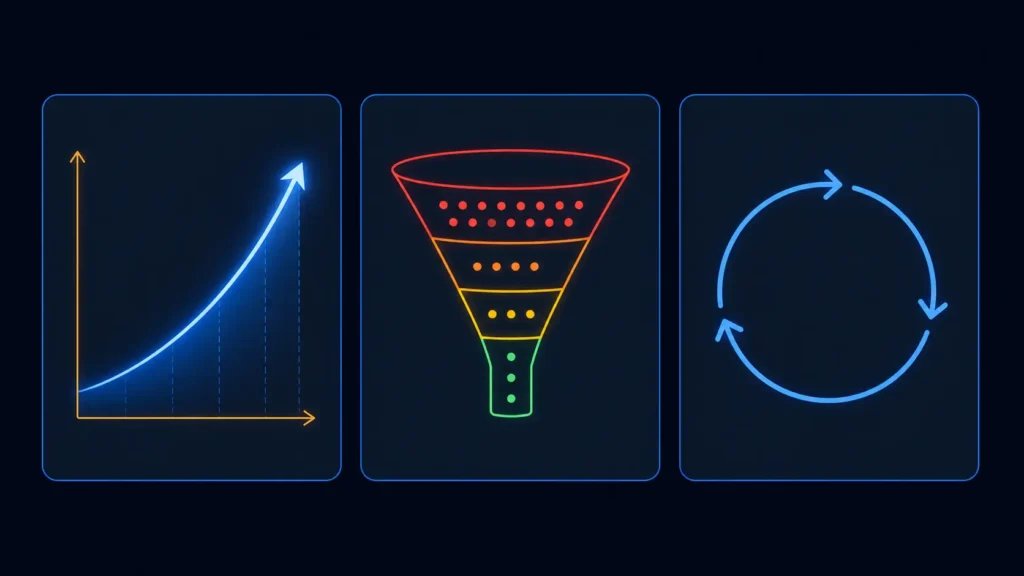
Shipping AI-driven differentiation is not the finish line — proving it produces learning outcomes faster than the control condition is. Three metrics signal whether your implementation of how to use AI to differentiate instruction is working.
Learning velocity. Measure how many concepts a student masters per hour of system engagement versus a baseline cohort. If the differentiated path produces faster mastery per hour, the personalization is doing its job. If it does not, your routing logic or your content graph has gaps.
Error recovery rate. Track how many attempts students need after an initial wrong answer to reach correct response. Good differentiation reduces this number because the system accurately diagnoses the misconception and addresses it directly. Bad differentiation serves the same content in a loop and produces the same error repeatedly.
Engagement without gamification. Time-on-task and voluntary return rate tell you whether students experience the system as genuinely helpful or as a chore. AI differentiation done well produces intrinsic pull — students stay because the difficulty feels calibrated to their ability, which cognitive science identifies as the core driver of flow states. If you need heavy extrinsic reward mechanics to sustain engagement, the difficulty calibration is off.
Run controlled experiments. Assign matched cohorts to differentiated and non-differentiated tracks. Measure at two weeks and eight weeks. The signal at eight weeks is more reliable than the signal at two weeks because early novelty effects contaminate short-term data.
The gap between knowing that AI can differentiate instruction and actually shipping a system that does it rigorously is where most EdTech products stall. Build the learner state model first, map the content graph second, and let the AI route within those structures — not around them.
Teams that execute this sequence ship faster, iterate on real outcome data, and build defensible product moats that a general-purpose chatbot cannot replicate.
How to Use AI to Write IEP Goals in Minutes (Free Tools + Prompts) How to Use AI to Write IEP Goals in Minutes (Free Tools + Prompts) | SagarAIHub IEP GoalsAI for TeachersSpecial EducationFree ToolsChatGPT Prompts ⚡ Quick Summary: In this guide you will learn exactly how to use AI to write IEP goals using free tools like MagicSchool AI and ChatGPT. Includes copy-paste prompts for every area of need — reading, math, social skills, behavior, speech, and more. If you are a special education teacher, you already know the pain of IEP season. One student. Multiple goals. Specific language. Measurable criteria. Legal compliance. And you still have 15 more students on your caseload waiting. Learning how to use AI to write IEP goals is one of the best time-saving decisions any SPED teacher can make in 2026. AI can write a strong first draft of your IEP goals in under 60 seconds — completely free. In this guide I will show you exactly how to use AI to write IEP goals, which free tools work best, and the exact prompts you can copy and paste right now. What Are IEP Goals and Why Are They So Hard to Write? An IEP (Individualized Education Program) goal is a specific, measurable statement describing what a student with a disability is expected to achieve within one year. Every IEP goal must include five key components: Condition: Under what circumstances will the student perform? Student name: Who will demonstrate the skill? Behavior: What specific, observable action will they perform? Criterion: How well and how often must they perform it? Timeframe: By when will this be achieved? A well-written IEP goal looks like this: ✅ Example IEP Goal “Given a graphic organizer and verbal prompting, [Student Name] will write a 5-sentence paragraph with a topic sentence, 3 supporting details, and a closing sentence with 80% accuracy across 4 out of 5 trials by the end of the IEP period.” Writing that from scratch — for every student, every goal, every year — takes enormous time and mental energy. That is exactly why so many special education teachers are now learning how to use AI to write IEP goals and saving hours every single week. Can AI Really Write IEP Goals? Yes — with the right prompts. AI cannot replace your professional judgment. It does not know your student, their evaluation data, or your district standards. You do. But once you know how to use AI to write IEP goals effectively, AI handles the heavy lifting of drafting the goal language. You spend your time refining, not starting from zero. Think of it this way: AI writes the first draft in 30 seconds You spend 5 minutes making it perfect Total time: 5–6 minutes instead of 30–45 Multiply that across a full caseload and you save hours every IEP season. Best Free AI Tools to Write IEP Goals 🪄 MagicSchool AI FREE magicschool.ai · Best overall tool MagicSchool AI has a dedicated IEP Goal Writer built specifically for special education teachers. It is the best free tool for learning how to use AI to write IEP goals right now. How to use it: Go to magicschool.ai and create a free account Search “IEP Goal Writer” in the tool library Enter student’s area of need, grade level, and current performance Click Generate and review the output Unlike generic AI tools, MagicSchool understands education language. Goals it generates already use SMART format and appropriate special education terminology. Time to generate: under 30 seconds. 🤖 ChatGPT Free Version FREE chatgpt.com · Most flexible option ChatGPT is the most flexible way to use AI to write IEP goals. With the right prompt it generates excellent goals for any area of need, any grade level, and any disability category. The exact prompts are below. 📚 Eduaide.AI FREE PLAN eduaide.ai · Great for SPED-specific tasks Eduaide has a dedicated IEP goal generator as part of its special education toolkit. Less well known than MagicSchool but equally powerful when learning how to use AI to write IEP goals for specific disability categories. 🔍 Google Gemini FREE gemini.google.com · Best for data-based goals Google Gemini works well for IEP goals when given detailed prompts. Best used when you want to use AI to write IEP goals based on uploaded evaluation reports or assessment data. How to Use AI to Write IEP Goals: The Master Prompt This is the most important section of this guide. Copy and paste this exact prompt into ChatGPT or any AI tool to get your first set of IEP goals in under 60 seconds. 📋 Master Prompt Template — Copy & Paste”You are an experienced special education teacher with expertise in writing legally compliant, SMART IEP goals. Write 3 IEP goals for a student with the following profile: – Grade level: [ENTER GRADE] – Disability category: [ENTER DISABILITY] e.g. Learning Disability, Autism, ADHD, Speech/Language Impairment – Area of need: [ENTER AREA] e.g. Reading comprehension, Math calculation, Written expression, Social skills, Communication – Current performance level: [DESCRIBE WHAT STUDENT CAN DO NOW] – Setting: [ENTER SETTING] e.g. Resource room, Inclusive classroom Each goal must follow SMART format and include: – Condition – Student behavior – Measurable criterion (percentage or frequency) – Timeframe (by end of IEP period) Write in formal IEP language suitable for a legal document.” Example Filled-In Prompt: ✏️ Filled In Example”You are an experienced special education teacher with expertise in writing legally compliant SMART IEP goals. Write 3 IEP goals for a student with the following profile: – Grade level: Grade 4 – Disability category: Learning Disability (Dyslexia) – Area of need: Reading comprehension – Current performance: Student reads at Grade 2 level, can decode CVC words but struggles to identify main idea and supporting details in grade-level text – Setting: Resource room 30 minutes daily plus inclusive classroom” Example AI Output: Here is what AI generates when you correctly use AI to write IEP goals with this prompt: 📌 Goal 1 — Reading Comprehension
You don’t run a school—but you absolutely run learning systems. Onboarding, internal training, product education, customer success playbooks—all of these depend on structured lesson plans. Most teams treat them as side work. That mindset slows execution. When you understand how to use ChatGPT to make lesson plans, you compress hours of planning into minutes. You also standardize quality across teams. Instead of relying on one “good trainer,” you create a repeatable system. Here’s the reality: founders at Series A don’t struggle with ideas. They struggle with bandwidth. Writing structured, outcome-driven lesson plans requires time, domain clarity, and iteration. ChatGPT eliminates the first two constraints and accelerates the third. Let’s break it down from a business lens: If you ignore how to use ChatGPT to make lesson plans, you force your team to reinvent structure every time. That cost compounds. The exact workflow: how to use ChatGPT to make lesson plans that scale You don’t need prompts—you need a system. Most people fail because they ask vague questions. You need structured inputs and iterative refinement. Start with a simple framework: Here’s a real example of how to use ChatGPT to make lesson plans for onboarding a new sales hire: Step 1: Input a structured prompt“Create a 5-day lesson plan for onboarding a SaaS sales executive. Include daily objectives, key concepts, exercises, and measurable outcomes. Audience: beginner-level sales hire. Goal: close first deal within 30 days.” This prompt works because it removes ambiguity. When you learn how to use ChatGPT to make lesson plans, clarity in inputs determines output quality. Step 2: Force structureAsk ChatGPT to format like this: You’re not asking for content—you’re asking for a system. Step 3: Iterate for depthTake Day 1 and refine:“Expand Day 1 into a 60-minute detailed session with scripts, roleplay scenarios, and evaluation criteria.” This step separates average users from high-leverage operators. Knowing how to use ChatGPT to make lesson plans means you never accept the first output. Step 4: Add real-world constraints“Adjust this plan assuming the trainee only has 2 hours per day and no prior SaaS experience.” Now the lesson becomes usable, not theoretical. This workflow turns ChatGPT into a planning engine—not a content generator. Real ROI: how to use ChatGPT to make lesson plans inside your company Let’s move beyond theory. Here’s how founders actually apply how to use ChatGPT to make lesson plans across functions. 1. Employee onboarding Instead of generic docs, create structured learning paths. Example: You use ChatGPT to generate each week’s lesson plan, including exercises and checkpoints. Result: new hires ramp faster. 2. Customer education Most startups lose users because they don’t educate them. Use how to use ChatGPT to make lesson plans to build: Ask:“Create a 3-module lesson plan to help users master [feature]. Include examples, exercises, and success metrics.” Now your “help section” becomes a structured learning journey. 3. Internal skill development You don’t need expensive trainers. Want your marketing team to improve ad performance?Use how to use ChatGPT to make lesson plans like this:“Create a 7-day advanced Meta Ads training plan for intermediate marketers. Focus on scaling campaigns and reducing CPA.” You instantly get a curriculum your team can execute. 4. Founder-led knowledge transfer You hold critical knowledge—but you don’t have time to teach everyone. Use ChatGPT as a translator:“Convert my notes on fundraising strategy into a 5-session lesson plan for startup founders.” Now your thinking scales without your presence. The ROI doesn’t come from content—it comes from consistency and speed. That’s why understanding how to use ChatGPT to make lesson plans gives you leverage. Advanced tactics: how to use ChatGPT to make lesson plans that outperform humans Most people stop at “generate a plan.” That’s baseline. You want compounding advantage. 1. Layer expertise into prompts Don’t ask generic questions. Inject context. Instead of:“Create a lesson plan on SEO” Say:“Create a 5-day SEO lesson plan for early-stage founders focusing on quick wins, technical audits, and content ROI. Avoid beginner definitions.” Now ChatGPT aligns with your level. 2. Use constraint-driven planning Constraints improve output. Examples: When you refine how to use ChatGPT to make lesson plans, constraints act as quality filters. 3. Build modular lesson blocks Instead of one large plan, generate reusable components: Then assemble them into custom lesson plans based on need. This turns ChatGPT into a content library generator. 4. Simulate real-world scenarios Ask for practical environments:“Include real startup scenarios where users must solve problems using the lesson concepts.” This removes fluff and increases retention. 5. Add evaluation systems Most lesson plans fail because they lack measurement. Always include: Example prompt:“Add performance metrics and evaluation criteria to each lesson.” Now your lesson plans drive outcomes, not just learning. 6. Iterate like a product Treat lesson plans like product features: When you truly master how to use ChatGPT to make lesson plans, you stop thinking in documents—you think in iterations. Written By SagarAiHub.com External Resources for “How to Use ChatGPT to Make Lesson Plans” Source Type Link Why It Matters Suggested Usage in Article OpenAI Official Documentation https://platform.openai.com/docs Primary source explaining how ChatGPT works and how prompts affect output quality Use in introduction or workflow section to support prompt engineering concepts Edutopia Education Resource https://www.edutopia.org/article/chatgpt-teachers Provides practical insights on using ChatGPT in teaching and lesson planning Use in education or lesson planning examples section Harvard Business Review Business Authority https://hbr.org Covers AI-driven productivity, efficiency, and ROI in organizations Use in ROI and business impact section MIT Sloan Academic/Business Insights https://mitsloan.mit.edu/ideas-made-to-matter Focuses on AI transformation in modern organizations Use in advanced strategy or scaling section UNESCO Global Authority https://www.unesco.org/en/artificial-intelligence/education Offers global perspective on AI in education and future learning systems Use in conclusion or long-term impact discussion
The Best Free AI Tools for Teachers 2026 Are Your Fastest Shortcut Into the AI Industry Every beginner who cracked AI fast did it with the same unfair advantage — they learned on free tools built for teachers, not engineers. Most people entering the AI industry assume they need a CS degree, a paid Coursera subscription, or six months of self-study before they touch anything real. That assumption costs them a year. The best free AI tools for teachers 2026 shatter that assumption completely — because they strip away jargon, give you working models on day one, and reward curiosity over credentials. If you want to build real AI skills fast, start where educators start, not where researchers start. This article lays out exactly which tools to use, how to sequence them, and what you can realistically build in 30 days — all without spending a cent. Why Beginner AI Learners Learn Faster With Teaching-Focused Tools The AI industry’s biggest onboarding failure is throwing beginners at developer-first documentation. PyTorch tutorials assume you already know matrix calculus. OpenAI’s API docs assume you know what a REST endpoint is. Teaching-focused tools make the opposite assumption — that you know nothing, and that your job is to figure things out by experimenting, not reading theory. Google’s Teachable Machine, for instance, lets you train an image classifier in under four minutes using your webcam. No code. No cloud setup. No API key. You drag photos, hit “train,” and watch a neural network learn what a thumbs-up looks like versus a peace sign. That single four-minute session teaches you more about supervised learning than two hours of watching a lecture — because you feel the feedback loop. You see your model fail, adjust your data, and fix it yourself. That is how experts actually think about ML, just compressed into a beginner interface. This is the core argument: the best free AI tools for teachers 2026 accelerate beginners not because they are simple, but because they make complexity visible without making it prerequisite. You interact with real AI systems — transformer models, classifiers, generative pipelines — through interfaces designed to surface what matters, not hide it. 4 min To train your first model with Teachable Machine $0 Total cost of the starter stack below 30 days To build demonstrable AI fluency The Exact Free AI Tool Stack to Use in 2026 Not every free tool earns a place in your learning stack. Some are demos with no depth. Others require institutional login access that blocks most new learners. The tools below are accessible to anyone with a browser, actively maintained heading into 2026, and genuinely useful — not just impressive-looking toys. These are the best free AI tools for teachers 2026 that also serve as the ideal AI beginner curriculum. Teachable Machine Train image, sound & pose classifiers. No code. Instant feedback on data quality. Google Colab (Free Tier) Run Python and Jupyter notebooks with free GPU. Your first real coding environment. ML for Kids Build Scratch-based AI projects. Forces you to think about training data before models. Hugging Face Spaces Run and fork live AI demos — text, image, audio. See production models, read their code. fast.ai (Free Course) Top-down practical deep learning. Builds a working model in lesson one, explains later. Claude.ai / ChatGPT Free Your AI pair-programmer. Use it to explain code errors, generate test datasets, debug logic. Sequence matters more than tool choice. Start with Teachable Machine to feel the data-model-prediction loop. Move to ML for Kids to practice labeling and dataset design decisions. Then open Hugging Face Spaces and start forking demos — reading the code behind tools you just used. By week three, open Google Colab and run your first notebook. The fast.ai free course runs parallel to all of this, one lesson per week. This stack builds conceptual understanding and hands-on capability simultaneously, which is exactly what the best free AI tools for teachers 2026 are designed to do. From Zero to Demonstrable: What You Actually Build in 30 Days Beginners make the mistake of measuring progress by content consumed — hours watched, articles read, courses completed. Founders and hiring managers measure AI fluency differently: they want to see what you built, what broke, and what you did about it. Thirty days on the free stack above produces three concrete artifacts that demonstrate real AI literacy. Week one produces a working image classifier with documented accuracy — you define the problem, collect your own training data, train the model, and write two paragraphs about why it underperforms on edge cases. Week two produces a text classification project on Hugging Face: you fork an existing sentiment analysis model, retrain it on a custom dataset you build yourself, and deploy it as a public Space. Week three opens Colab — you run a computer vision notebook end-to-end, change hyperparameters deliberately, and document what each change did to validation accuracy. Week four connects everything: you write a one-page technical brief explaining the tradeoffs between three approaches to your original problem from week one. That four-week output — three working projects plus a written technical analysis — gives any beginner more credibility than most six-month bootcamp certificates. It exists because you used the best free AI tools for teachers 2026 the way their designers intended: as scaffolding for experimentation, not passive instruction. Why Free AI Tools Give Beginners a Structural Advantage in 2026 Paid courses create a dangerous illusion of progress. You complete modules, collect badges, and feel like you understand machine learning — but you never fought with a bad dataset, debugged a broken training loop, or explained a model’s failure to yourself in plain language. Free tools remove the completion-metric reward system entirely. Nobody congratulates you for finishing Teachable Machine. You build something, it either works or it does not, and you figure out why. The best free AI tools for teachers 2026 also reflect where the industry actually operates. The biggest shift in applied AI over the last two years is not model architecture — it is data quality, prompt