

A teacher who spends ninety minutes building a single grading rubric by hand is losing time she will never get back, and she is losing it for no good reason, because an AI rubric generator for teachers free can produce the same rubric — often a better one — in under five minutes.
Table of Contents
The Real Cost of Manual Rubric Building

Rubric writing looks like a small task until someone actually times it. A teacher designing a rubric for a persuasive essay unit has to define performance bands, write descriptors for each criterion at each level, check the language for consistency, align it to a state or district standard, and format it so students can actually read it. That process routinely eats sixty to ninety minutes per rubric, and most teachers build multiple rubrics per unit, per semester, per course load.
Multiply that across a school. A middle school with forty teachers, each producing even four original rubrics a semester, burns somewhere around 240 hours of instructional planning time on a task that does not require a subject-matter expert typing from scratch — it requires a subject-matter expert reviewing and refining a draft. That distinction matters. An AI rubric generator for teachers free of charge does not replace the teacher’s judgment; it removes the blank-page problem and hands the teacher a structured draft to edit instead of author.
Compare that to the adoption curve of other classroom tools. Google Classroom did not win because it did something teachers couldn’t do manually — it won because it collapsed a slow manual process (collecting, sorting, and returning paper assignments) into something that took seconds. An AI rubric generator for teachers free from clunky manual work follows the same logic: it is not solving a problem of capability, it is solving a problem of time, and time is the one resource a classroom teacher cannot manufacture more of.
The hidden cost shows up again at grading time, not just at rubric-creation time. A vague, hastily written rubric produces inconsistent grading decisions across a stack of thirty papers, because the teacher’s interpretation of “strong argument” on paper one drifts by paper twenty-five, especially late in the evening after a full teaching day. A well-structured rubric with specific, distinct language at each performance level keeps that judgment consistent from the first paper to the last. That consistency is worth more to a teacher’s workload than the time saved building the document in the first place, because inconsistent grading is what triggers grade disputes, parent emails, and re-grading requests — all of which cost far more than ninety minutes.
There’s also a compounding effect across a career. A teacher who builds forty original rubrics over the first five years of teaching, entirely by hand, has sunk close to sixty hours into a task that a well-edited AI draft could have handled in a tenth of the time, freeing that same teacher to spend the difference on lesson design, one-on-one student feedback, or simply going home on time. None of that is a hypothetical productivity claim; it’s the direct arithmetic of removing a repetitive drafting task from a job that already has too many of them.
Where the “Free” Part Actually Holds Up

Skepticism about “free” EdTech tools is fair. A lot of free tiers exist purely to harvest usage data before forcing a paywall the moment a teacher becomes dependent on the tool. The question worth asking isn’t whether a tool is free — it’s whether the free tier produces a rubric that is actually usable in a real classroom, on the first try, without an upgrade prompt blocking the export.
Tools built around large language models, including the newer generation of AI rubric generator for teachers free platforms, can genuinely sustain a free tier because the marginal cost of generating one rubric is small compared to the cost structures that made older EdTech software expensive — licensing per seat, hosting large content libraries, or maintaining a sales team to sell district-wide contracts. A rubric generator built on top of a modern language model can serve a teacher a usable four-criteria, four-level rubric for a fraction of a cent in compute cost.
That is a fundamentally different economic model than the CD-ROM-era gradebook software districts used to pay thousands of dollars a year for, and it is why a genuinely useful, no-cost AI rubric tool for teachers is not a contradiction in terms — it is a predictable outcome of how the underlying technology is priced.
The teachers who get the most value from these tools tend to follow a simple pattern: they generate a first draft, they edit the descriptor language to match their own voice and their students’ reading level, and they save the result as a reusable template. That workflow takes ten minutes total, compared to the ninety minutes of starting from a blank document, and it produces a rubric that still reflects the teacher’s professional judgment rather than a generic default.
It’s worth separating two different kinds of “free” that get used interchangeably in EdTech marketing. The first is a genuinely sustainable free tier, where a teacher can generate and export a full rubric with no paywall blocking the part of the workflow that actually matters. The second is a bait-and-switch free tier, where the generation step is free but the export, the editing, or the saving of a template sits behind a subscription.
A teacher evaluating an AI rubric generator for teachers free tier should test the export step before trusting the tool with real planning time — if the free tier can’t produce a document a teacher can actually walk into class with, it isn’t really free, it’s a funnel.
The reason the sustainable version of “free” is realistic here, and wasn’t realistic for most EdTech tools a decade ago, comes down to how the underlying technology is priced. Older classroom software had to recoup fixed costs: server infrastructure sized for peak district-wide usage, in-house content libraries written by paid curriculum specialists, and account teams selling multi-year contracts to school boards.
A rubric generator built on a modern language model carries almost none of that overhead. Generating one rubric is a single API call, and the underlying model providers have driven the cost of that call down sharply over the past two years. That’s the specific economic shift that makes an AI rubric generator for teachers free of a subscription a stable business model rather than a temporary loss leader.
What Separates a Genuinely Useful Tool From a Gimmick
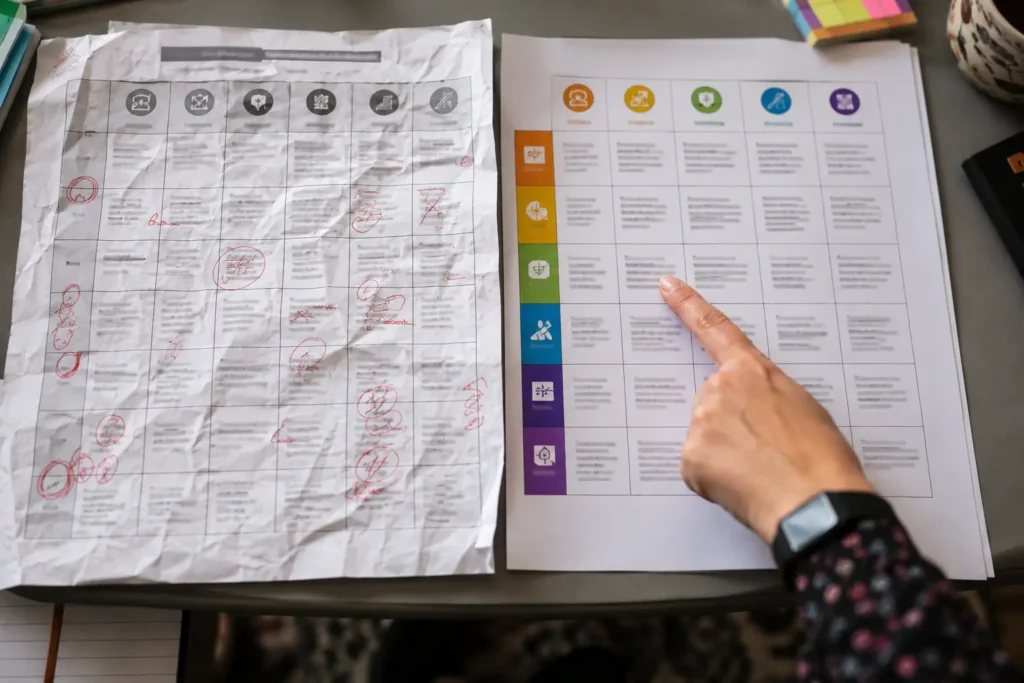
Not every AI rubric generator for teachers free tool is built the same way, and the differences show up fast once a teacher tries to use the output in a real classroom. Four things separate a tool worth keeping from one that gets abandoned after one use.
Standards alignment. A rubric that ignores Common Core, state standards, or a district’s specific competency framework creates more work than it saves, because the teacher has to retrofit the language afterward. The stronger generators let a teacher paste in or select the standard they’re targeting and generate descriptors that map directly to it.
Editable output, not locked templates. If a teacher can’t rewrite a single descriptor without starting the whole rubric over, the tool is a gimmick. Every teacher who has used one of these tools successfully describes the same workflow: generate, then edit line by line.
Descriptor quality at every performance level. It’s easy to write a strong “Exceeds Expectations” column. It’s much harder to write a “Developing” column that is specific enough to guide a struggling student toward improvement rather than just telling them they failed. Weak generators produce vague filler at the bottom of the rubric; strong ones produce actionable, specific language at every level.
Export formats that match how teachers actually distribute rubrics. A rubric trapped inside a proprietary web app is close to useless. Teachers need a Google Docs export, a PDF, or a format that drops cleanly into whatever LMS their school runs — Canvas, Schoology, or Google Classroom.
Teachers evaluating a new AI rubric generator for teachers free option should run one real test before adopting it: generate a rubric for an assignment they’ve already graded manually, and check whether the criteria and language would have produced grading decisions consistent with what they actually gave students. If the tool’s rubric matches a teacher’s own grading instincts most of the time, it’s ready for classroom use. If it doesn’t, no amount of polish in the interface makes up for that gap.
Consider a concrete example: a seventh-grade science teacher building a rubric for a lab report on the water cycle. A weak generator produces a criterion labeled “Scientific Accuracy” with a top-band descriptor like “shows excellent understanding” and a bottom-band descriptor like “shows little understanding” — language that tells a student nothing about what to fix.
A stronger tool produces top-band language like “correctly identifies and explains all four stages of the water cycle with accurate cause-and-effect relationships between stages” and bottom-band language like “identifies fewer than two stages, or describes stages without explaining the cause-and-effect relationship between them.” The second version gives the student, and the teacher, something specific to act on. That gap in descriptor quality is the single biggest differentiator between generators that get reused every week and generators that get tried once and abandoned.
Speed matters too, but only after quality is established. A generator that produces a usable rubric in ten seconds isn’t valuable if the teacher then has to spend twenty minutes rewriting every descriptor from scratch — that’s slower than starting from a blank page with a template the teacher already trusts. The generators that actually save time are the ones where the editing pass is light: swapping a few words, tightening a sentence, adjusting the point values, rather than rewriting whole columns.
The Bigger Pattern: AI Tools Win When They Remove Friction, Not When They Replace Judgment

The rubric generator conversation is really a smaller version of a bigger pattern playing out across education technology. Tools that try to replace teacher judgment — automated essay graders that assign final scores with no teacher review, for instance — tend to generate distrust and get quietly abandoned within a semester. Tools that remove friction from a task the teacher still controls tend to stick around, because they respect the fact that the teacher is the one accountable for the grade a student receives.
An AI rubric generator for teachers free of grading authority sits firmly in the second category when it’s built correctly. It doesn’t grade the student. It doesn’t make the final call on what “proficient” looks like for a ninth-grade lab report. It gives the teacher a fast, editable starting point and gets out of the way. That’s a narrower promise than “AI grading,” and it’s a more honest one — which is exactly why it’s more likely to survive contact with an actual classroom instead of getting quietly dropped after the first parent complaint about an AI-generated grade.
The teachers most likely to stick with these tools long-term aren’t the ones chasing novelty. They’re the department heads and instructional coaches who need to standardize rubric quality across ten or twenty teachers without spending a full professional development day doing it by hand. A shared rubric library built from an AI rubric generator for teachers free to use across the department, then reviewed and approved by department leads, solves a coordination problem that manual rubric writing never solved well in the first place — because it was never realistic to get twenty teachers to independently write equally rigorous rubrics without a shared starting point.
An AI rubric generator for teachers free from hidden paywalls earns its place in a classroom the same way any good tool does: by giving back time without asking the teacher to give up control. That trade is worth making, and the teachers already using these tools aren’t going back to the blank page.
Written By sagaraihub.com
Resources:
- Teachers report spending nearly ten hours a week on grading
- Teachers work far more hours than their contracted week
- Research on why teachers should grade less frequently
- Research on what makes rubric criteria effective
- CAST’s Universal Design for Learning guidelines
- A recent study on how K-12 teachers actually use AI-generated rubrics
