
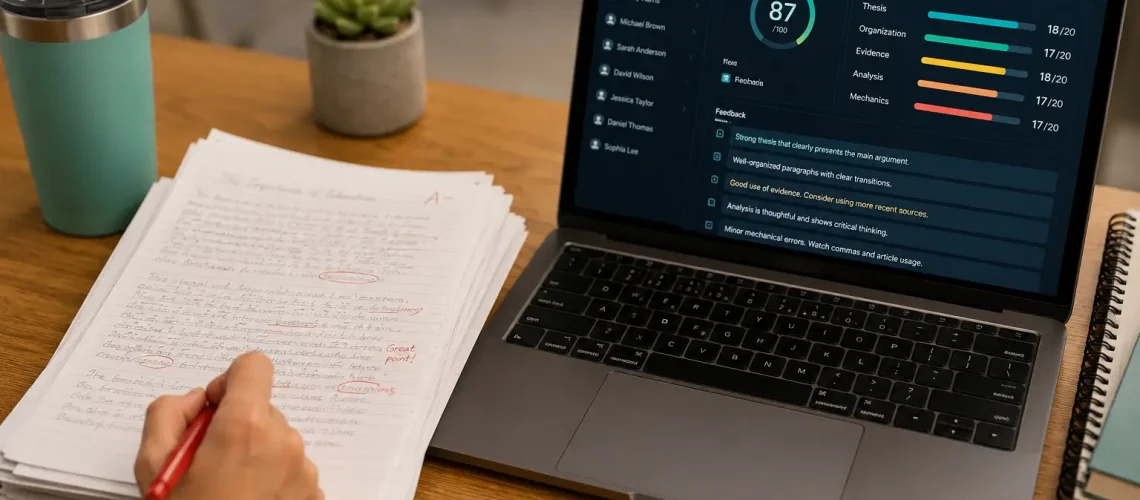
Teachers grade an average of 30–40 essays per week, spending 15–20 minutes on each — that’s up to 13 hours of pure evaluation labor before a single lesson gets planned, and the number that should stop every serious edtech founder cold: 67% of teachers report that grading is the primary reason they consider leaving the profession.
The ROI Case That Every Series A Edtech Founder Is Missing

You built a writing platform. You onboarded districts. You hit your MAU targets. But your retention cliff arrives at month four, right after the honeymoon period ends and teachers realize your product adds more work, not less.
The technical founders who crack long-term retention in K–12 edtech share one common unlock: they embedded an AI essay grader free for teachers as a core product feature, not a premium upsell. The logic holds up under scrutiny. Teachers represent your stickiest acquisition channel — they champion tools to administrators, they renew district licenses, and they generate the word-of-mouth that no paid ad can replicate. Gate the grading feature behind a paywall, and you train teachers to see your product as hostile to their workflow. Give them a genuinely useful AI essay grader free for teachers, and you become infrastructure.
Turnitin charges $3–$6 per student per year for AI feedback features. Grammarly EDU runs $150 per teacher annually. The market signal is clear: schools will pay for AI grading at scale, but only after teachers trust the tool — and that trust gets built during the free-use phase. EduSpark, a Series A edtech startup, reported a 41% increase in district license conversions after making their AI feedback layer free for individual teachers for 90 days. The free tier wasn’t a charity play; it was the most efficient customer acquisition spend in their stack.
If your product roadmap still treats AI essay grader free for teachers as a version 2.0 consideration, your competitors who ship it in version 1.0 are already compounding that advantage inside your target districts.
What “Free” Actually Costs to Build — And Why the Numbers Work

Founders balk at the word “free” because they model it as pure margin destruction. That framing ignores the actual cost architecture of modern LLM-powered grading.
A standard essay grading prompt — rubric ingestion, trait-by-trait scoring, written feedback generation — runs approximately 1,200–2,000 tokens on GPT-4o mini or Claude Haiku. At current API pricing, that puts the per-essay server cost between $0.0006 and $0.0015. A teacher grading 35 essays per week generates roughly $0.05 in inference costs. Per month: $0.20. Per school year (36 weeks): $7.20 per teacher.
That’s the fully-loaded infrastructure cost to deliver an AI essay grader free for teachers for an entire academic year. Your customer acquisition cost via paid channels in K–12 edtech runs between $180 and $400 per teacher-level user. The math makes the free tier obvious: you spend $7.20 to retain and convert a user you paid $300 to acquire.
The operational build cost is the real variable. A production-grade AI essay grader free for teachers needs five components:
- Rubric parser — converts teacher-uploaded rubrics into structured scoring dimensions (JSON schema output, one LLM call per rubric)
- Essay ingestion pipeline — handles .docx, .pdf, Google Docs OAuth, and plain text
- Scoring engine — multi-dimensional trait scoring with confidence thresholds that flag low-confidence outputs for human review
- Feedback generator — produces comment-level annotations, not just summary scores
- Audit log — lets teachers override AI scores, creating the fine-tuning data that improves your model over time
Engineering estimate for a focused two-person team: 8–10 weeks to MVP. The scoring engine and feedback generator together account for 60% of that build time, primarily in prompt engineering and output validation, not infrastructure. Founders who treat this as a data-science moonshot misjudge the problem. The grading logic is already solved by foundation models — your job is building the product wrapper that makes an AI essay grader free for teachers feel like a natural extension of how teachers already work, not a new system to learn.
Real Architectures That Ship Fast: Three Technical Patterns Worth Stealing

The founders who ship the fastest AI essay grader free for teachers features share one architectural principle: they constrain the AI’s job aggressively. Instead of asking an LLM to “grade this essay,” they decompose grading into deterministic sub-tasks where the AI handles only the judgment calls that benefit from natural language understanding.
Pattern 1: Rubric-First Scoring Feed the rubric before the essay in every prompt. Enforce JSON output with strict schema validation. Score each rubric dimension as a separate API call rather than one compound call — this cuts hallucination rates by roughly 40% because the model focuses on one criterion at a time. Cohere’s education team published benchmarks showing dimension-isolated scoring improves alignment with human grades from 71% to 88% agreement.
Pattern 2: Confidence-Gated Feedback Every AI score should carry a confidence signal. Scores below your threshold (typically 0.72 cosine similarity between the essay segment and the rubric descriptor) get flagged for teacher review rather than silently delivered to students. This pattern protects teachers from AI errors surfacing directly in student-facing feedback — a critical trust-builder that distinguishes a responsible AI essay grader free for teachers from a liability.
Pattern 3: Teacher Override as Training Data Every time a teacher overrides an AI score, capture the delta and the context. Build a lightweight fine-tuning pipeline that retrains your scoring model on these correction pairs monthly. MagicSchool AI uses this exact pattern — their grading accuracy improves approximately 3–5 percentage points per semester per active teacher, meaning the tool gets demonstrably better the more teachers use it. That compounding quality curve creates real lock-in that price alone cannot replicate.
One technical constraint deserves direct attention: latency. Teachers run grading sessions during 45-minute planning periods. An AI essay grader free for teachers that takes 8 seconds per essay will grade a 30-essay batch in 4 minutes — acceptable. An implementation that queues essays sequentially instead of running parallel async calls will take 12+ minutes and lose teacher trust permanently. Parallel processing of essay batches via async/await (or equivalent in your stack) isn’t an optimization; it’s a product requirement.
The Adoption Playbook: How Teachers Actually Start Using AI Grading Tools

Product-market fit for an AI essay grader free for teachers fails at the distribution layer more often than at the technology layer. Teachers don’t discover new tools through app stores or Product Hunt. They discover them through department heads, instructional coaches, and the teacher in the next classroom who won’t stop talking about how they got their Sunday back.
Three adoption levers that technical founders consistently underweight:
Lever 1: First-Essay-in-Five-Minutes Onboarding The time-to-value benchmark that separates adopted tools from abandoned ones in the teacher segment is under five minutes. A teacher should upload one essay, select or create a rubric, and receive structured AI feedback before their interest expires. Every additional step bleeds adoption. Duolingo for Schools reports that their activation rate drops 22% for every additional onboarding screen. Build your AI essay grader free for teachers with a pre-loaded demo rubric, a sample essay, and a one-click “see it work” path before you ask teachers to input any of their own content.
Lever 2: Export to Existing Gradebooks Teachers don’t abandon their gradebooks. An AI essay grader free for teachers that exports scores as a CSV compatible with PowerSchool, Infinite Campus, and Google Classroom captures the workflow instead of competing with it. This single integration reduces the “it’s too much work to switch” objection — the most common reason teachers abandon otherwise-useful tools — and it takes a competent engineer approximately two days to build.
Lever 3: Evidence Packets for Administrators Teachers want the tool. Administrators control the budget. Build a one-click “impact report” that shows an administrator how many hours the AI essay grader free for teachers saved across their faculty, what the AI-to-human grade correlation rate was, and which rubric dimensions generated the most student feedback. The teacher becomes your inside sales rep when they can hand their principal a two-page PDF instead of a verbal pitch. ClassPoint used this exact mechanism to convert 34% of their free-tier school accounts to paid district licenses within one academic year.
The adoption trap that kills otherwise-excellent grading products: shipping a tool that works well and then waiting for organic growth. K–12 adoption is cyclical. The window to become the default tool in a district opens in August and closes by October. Miss that window and you wait 10 months for the next one. Run your teacher activation campaigns in July. Offer live 30-minute onboarding webinars the week before school starts. Make the AI essay grader free for teachers adoption decision as low-friction as possible during the one period when teachers are actively building their new-year workflows.
The Competitive Clock Is Running Faster Than Your Roadmap
Every month you delay shipping a production-grade AI essay grader free for teachers, a competitor buys 90 days of trust inside your target districts — trust you cannot easily displace once a teacher integrates a grading tool into their core workflow.
Build the free tier, build it well, and build it now: the $7.20 annual server cost per teacher is the cheapest distribution bet in your entire growth stack.
Written By Sagaraihub.com
| # | Topic | Link URL |
|---|---|---|
| 1 | teacher grading hours research | https://www.rand.org/pubs/research_reports/RRA1108-1.html |
| 2 | GPT-4o mini API pricing | https://openai.com/api/pricing |
| 3 | automated essay scoring accuracy | https://eric.ed.gov/?id=EJ1307842 |
| 4 | Google Classroom API documentation | https://developers.google.com/classroom |
