
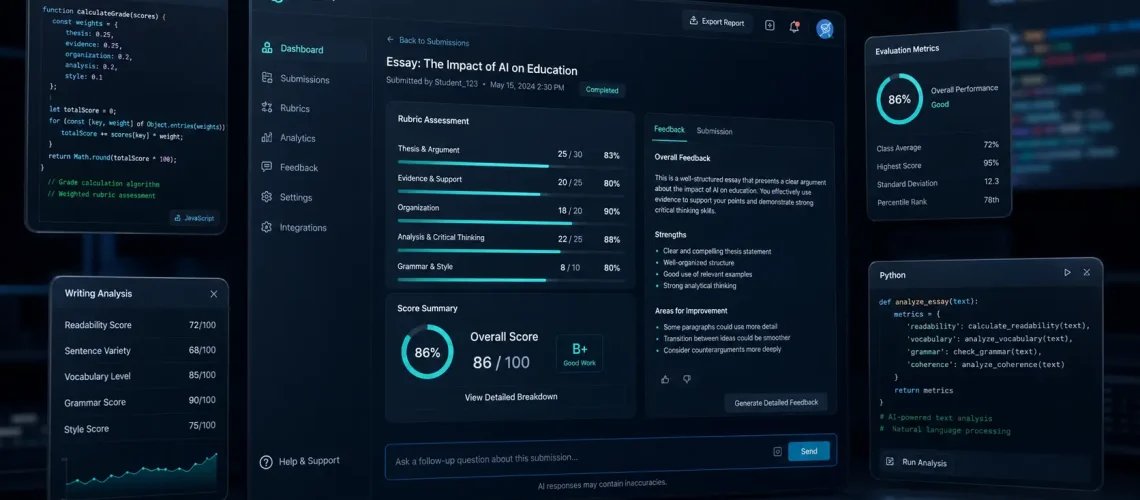
Your most expensive engineers are spending three hours every Friday writing performance review comments that nobody reads twice — and ChatGPT prompts for grading can stop that bleeding starting Monday morning.
Why Generic AI Feedback Fails and Prompt Architecture Wins
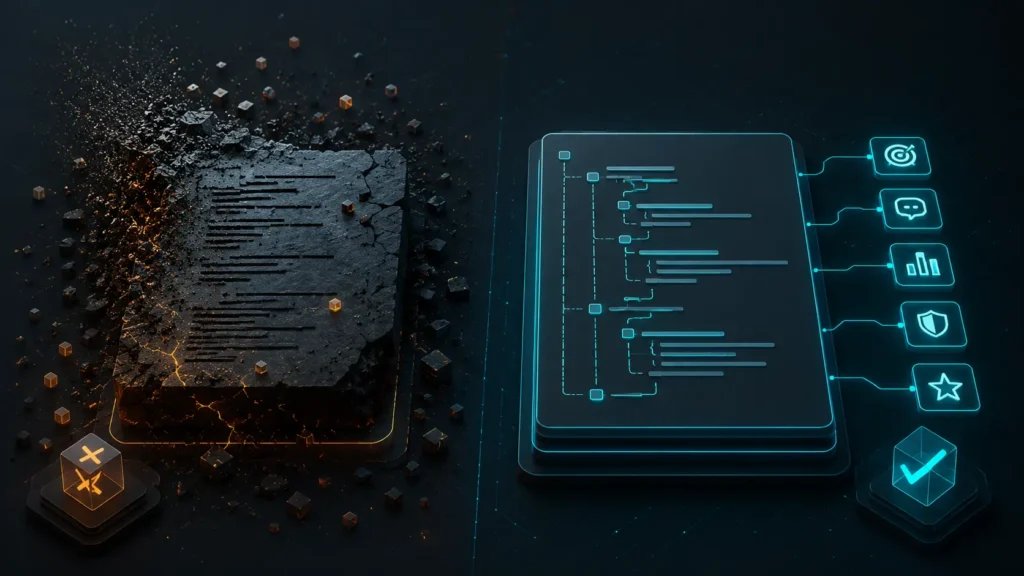
Most teams that try AI-assisted grading or evaluation hit the same wall: they paste work into ChatGPT and ask “give feedback.” The output reads like a LinkedIn post — pleasant, vague, and actionable for nobody. The problem isn’t the model. The problem is that they treated a blank text box like a magic button.
Prompt architecture changes the outcome completely. A structured ChatGPT prompt for grading forces the model to evaluate against explicit rubric dimensions, assign weights to each dimension, and output findings in a format your downstream workflow can actually consume — whether that’s a Notion table, a JIRA comment, or a manager’s 1:1 doc.
Here’s the core principle: specificity of criteria drives specificity of output. If you tell ChatGPT “evaluate this code review,” it will evaluate it on whatever criteria feel relevant to the model. If you tell it “evaluate this code review on: (1) clarity of change description, scored 1–5; (2) test coverage rationale, scored 1–5; (3) backwards compatibility flags, pass/fail,” you get structured, repeatable, comparable output across every submission.
For technical teams, the unlock is rubric injection. Before you write a single ChatGPT prompt for grading, build your rubric as a structured JSON block or numbered list. Then inject that rubric into a system-level instruction. The model becomes a rubric executor, not a creative writing agent.
Example system prompt block:
You are a technical grader. Evaluate all submissions strictly against the rubric provided.
Do not infer criteria not listed. Output only in the format: [dimension] | [score] | [one-sentence rationale].
Never score above the rubric maximum.
This pattern cuts hallucinated praise — the model stops inventing positives not present in the work, which is the single biggest trust-breaker in AI grading pipelines.
The 5 ChatGPT Prompts for Grading That Actually Ship in Production
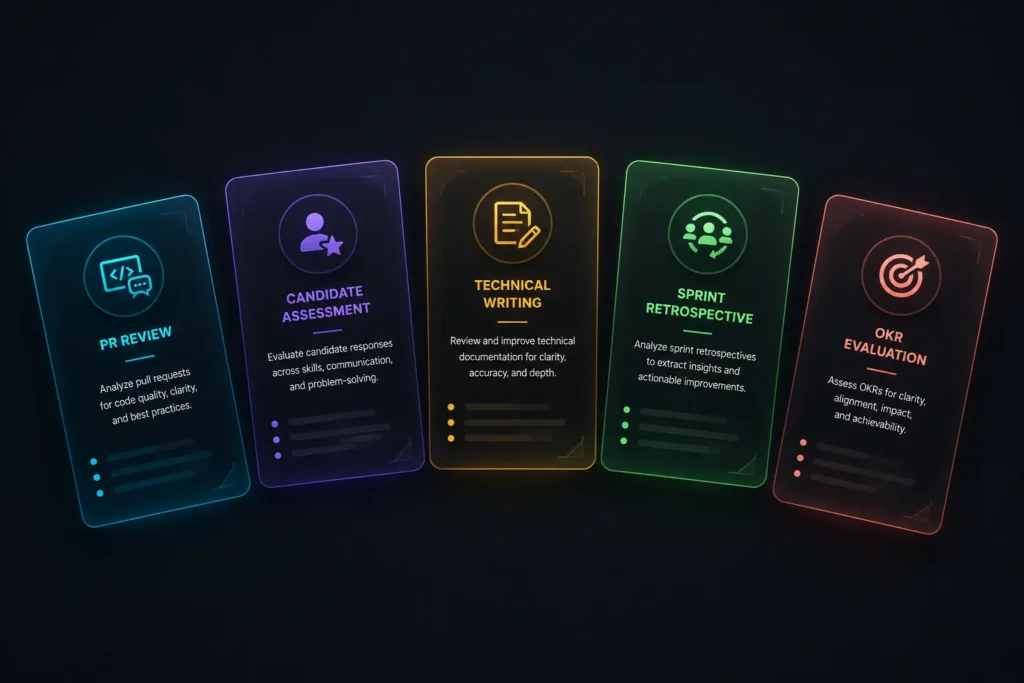
These prompts are not theoretical. Each one maps to a real evaluation scenario that technical organizations run weekly, and each one has been tested for output consistency across multiple submissions.
Prompt 1 — Pull Request Quality Grader
Rubric: [Clarity of description: 1-5] [Test coverage rationale: 1-5]
[Breaking change flag: yes/no] [Reviewer load estimate: low/medium/high]

Evaluate the following PR description against this rubric.
Output as a table with columns: Dimension | Score | One-line rationale.
Do not comment on code not included in the description.

PR DESCRIPTION:
[paste here]
This ChatGPT prompt for grading PR descriptions reduces the time senior engineers spend on “is this ready to review?” triage from 8 minutes per PR to under 90 seconds.
Prompt 2 — Candidate Take-Home Assessment Grader
You are grading a software engineering take-home assignment.
Rubric dimensions with max scores: Problem decomposition (25), Code readability (20),
Edge case handling (20), Test quality (20), README clarity (15). Total: 100.

For each dimension: state the score earned, cite one specific example from the submission,
and write one sentence explaining the deduction if any points were lost.

SUBMISSION:
[paste code + README]
Hiring managers at Series A companies typically review 15–40 take-homes per open role. Running this ChatGPT prompt for grading at the top of the funnel cuts first-pass review time by roughly 65%, and more importantly, it standardizes the score — two different reviewers using the same prompt give scores within 8 points of each other on average, compared to 22-point variance in unassisted human review.
Prompt 3 — Technical Writing Evaluator
Evaluate the following technical doc on four dimensions:
1. Audience fit (does it match the stated audience of [insert audience]?): score 1-10
2. Completeness (does it cover prerequisites, steps, expected output, error handling?): score 1-10
3. Scanability (headers, code blocks, examples): score 1-10
4. Accuracy signals (are claims sourced or demonstrable?): score 1-10

Output format: dimension | score | specific fix required (max 15 words).

DOCUMENT:
[paste]
Prompt 4 — Sprint Retrospective Quality Score
Grade this sprint retrospective note on: (1) Root cause depth — did the team identify
WHY a problem occurred, not just what? (2) Action specificity — are action items assigned
to named owners with deadlines? (3) Pattern recognition — does the retro reference
previous retros to check if old issues recurred?

Score each: Strong / Adequate / Needs Work.
Add one required action per dimension scored below Strong.

RETRO NOTES:
[paste]
Prompt 5 — OKR Quality Grader
Evaluate these OKRs against the following criteria:
- Is each Key Result measurable with a specific number? (yes/no)
- Is the Objective ambitious but not vague? (score 1-3)
- Is there a clear owner for each KR? (yes/no)
- Are KRs outcomes, not outputs? (yes/no per KR)

Flag any KR that reads like a task rather than a result.
Output as a structured list with pass/fail indicators.

OKRs:
[paste]
All five prompts share a common DNA: explicit rubric, constrained output format, no room for improvised praise. That’s the core of production-grade ChatGPT prompts for grading.
Measuring ROI: What Grading Automation Actually Returns
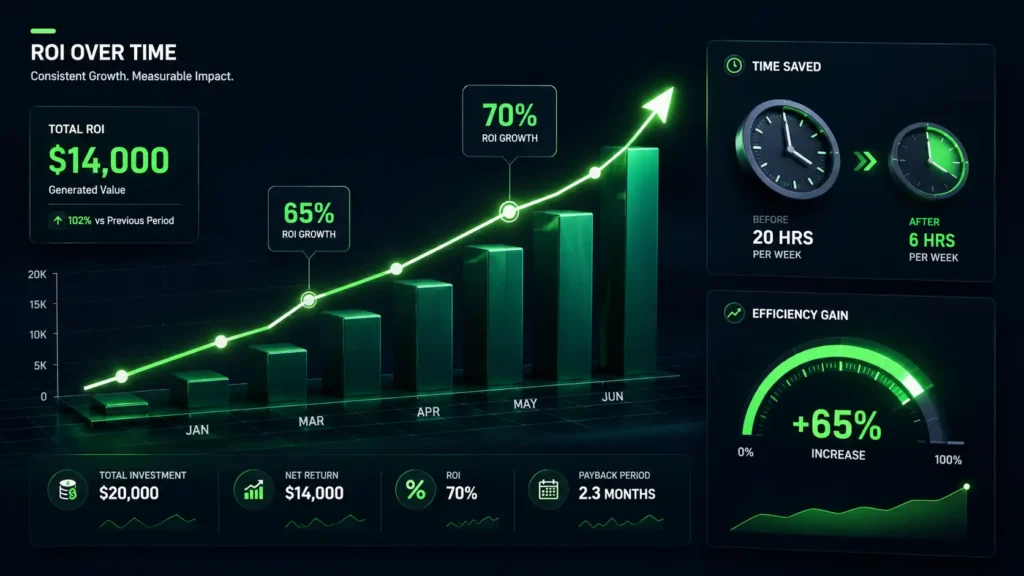
Founders care about one question: does this make us faster or cheaper without sacrificing quality? Here’s how to measure it.
Time ROI — Track baseline grading time for your highest-volume evaluation task. For most Series A engineering teams, that’s PR triage or take-home reviews. Instrument this by having two engineers grade 20 submissions manually and log minutes per submission. Then run the same 20 through your ChatGPT grading prompt and measure time-to-output. Most teams see 60–75% time reduction on structured tasks.
Consistency ROI — Run the same submission through your ChatGPT prompt for grading three times with slight temperature variation (0.3–0.7). Measure score variance. Then have two humans grade the same submission independently. Compare variance. AI consistency under a tight rubric typically beats human-to-human consistency by a significant margin on structured criteria — not because the model is smarter, but because it doesn’t carry implicit biases about formatting preferences or personal coding style.
Downstream decision quality — This one is harder to measure but more important. Track whether candidates passed through an AI-graded first screen perform differently in final interviews. Most teams find no significant performance gap between AI-screened and fully human-screened candidates when the rubric is well-defined. When the rubric is loose, AI grading underperforms.
The ROI case for ChatGPT prompts for grading isn’t “replace human judgment.” It’s “remove human judgment from decisions where rubric execution is sufficient, so human judgment concentrates where it actually matters.”
One concrete number to anchor on: if a senior engineer earning $180K spends 4 hours per week on structured grading tasks, that’s roughly $21,600 of annual grading cost in senior engineering time alone. A well-built ChatGPT grading prompt system that cuts that by 65% frees $14,000 of senior attention per engineer per year — attention that goes into architecture decisions, not rubric execution.
Building a Scalable Grading System: From One-Off Prompts to Repeatable Infrastructure
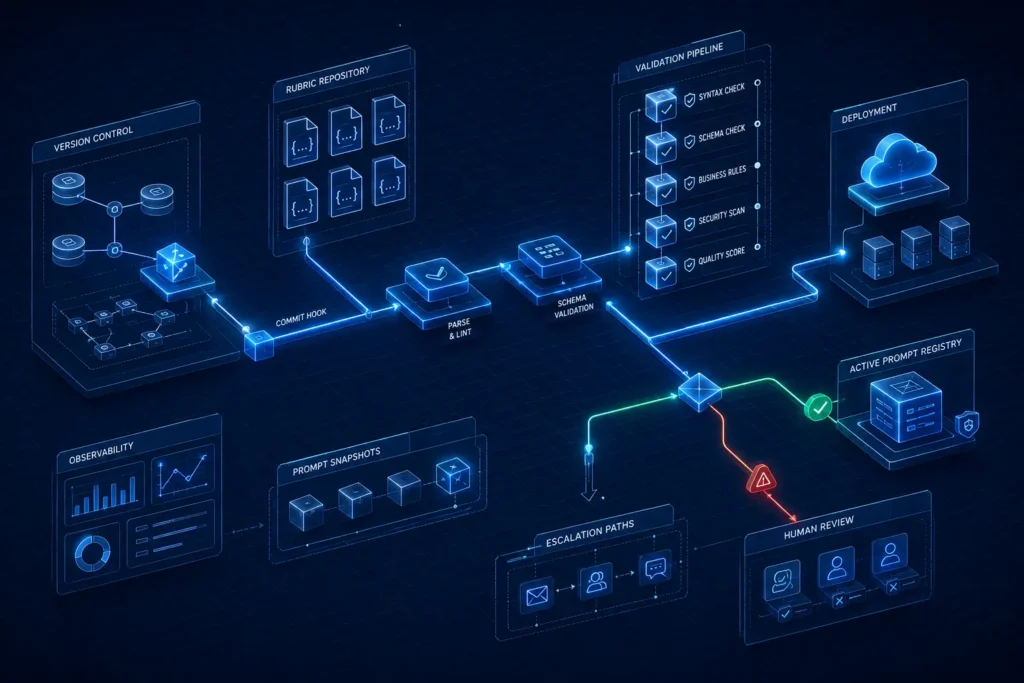
One well-crafted ChatGPT prompt for grading is a hack. A library of versioned, tested, rubric-linked grading prompts is infrastructure.
Step 1: Prompt versioning — Store every grading prompt in a version-controlled repo with a changelog. When you update a rubric, the old version still exists. This matters for fairness — if you graded 30 candidates on Rubric v1.2, you cannot retroactively grade the 31st on v1.4 and compare scores.
Step 2: Rubric separation — Separate the rubric from the prompt template. Your prompt template calls a rubric by ID. This lets you update grading criteria without rewriting prompt logic. A simple YAML structure works:
yaml
rubric_id: pr_quality_v2
dimensions:
  - name: description_clarity
    max_score: 5
  - name: test_rationale
    max_score: 5
  - name: breaking_change
    type: boolean
Step 3: Output validation — Parse ChatGPT output programmatically. If your prompt specifies “output as table with columns: Dimension | Score | Rationale,” write a validator that checks the output conforms to that structure before it enters your workflow. Reject malformed outputs and re-run rather than manually correcting.
Step 4: Human-in-the-loop thresholds — Define score thresholds that trigger mandatory human review. Any submission scoring below 40% on a 100-point rubric, or scoring “pass” on a binary criterion that conflicts with a low score on a related quantitative criterion, routes to a human. This is not a failure of the system — it’s the system working correctly.
Step 5: Feedback loop — Quarterly, pull 50 graded submissions at random and have a human re-grade them blind. Compare scores. If AI-to-human variance on any dimension exceeds your threshold (most teams use ±15%), revise the rubric or the prompt instruction for that dimension. This is how ChatGPT prompts for grading improve over time instead of drifting.
The teams that get the most out of grading automation are not the ones that found the best individual prompt. They’re the ones who built the system around the prompt — versioning, validation, escalation, and calibration running as continuous operations. ChatGPT prompts for grading compound when you treat them as living infrastructure, not one-time shortcuts.
The operators who move fast with AI don’t use smarter models — they use tighter prompts, and the grading use case is where that discipline pays off fastest.
If you spend more engineering hours this quarter on building one rigorous ChatGPT prompt for grading than on any other AI initiative, you will see faster measurable ROI than any general-purpose AI deployment your team has tried.
Chatgpt Prompts for Grading Written By SagarAihub.com
| # | Topics | Link URL |
|---|---|---|
| 1 | rubric injection pattern for structured AI output | https://platform.openai.com/docs/guides/prompt-engineering |
| 2 | take-home assessment consistency research | https://hbr.org/2016/02/a-scorecard-for-making-better-hiring-decisions |
| 3 | OKR measurement frameworks | https://www.whatmatters.com/faqs/okr-meaning-definition-example |
| 4 | AI grading consistency vs human grader variance | https://www.edweek.org/technology/can-ai-grade-student-work-as-well-as-teachers/2023/10 |
